 Français
 English

| ELK.No | ES10109 |
| Product name | RAC3 rabbit pAb |
| Reactivity | Human;Mouse |
| Applications | WB;ELISA |
| Other name | |
| Size | 100μL |
| Unit price ($) | 248 |
| Human gene ID | 5881 |
| Human Swiss-Prot | P60763 |
| Source | Rabbit |
| Isotype | IgG |
| Target | RAC3 |
| Fields | >>MAPK signaling pathway;>>Ras signaling pathway;>>Rap1 signaling pathway;>>cAMP signaling pathway;>>Chemokine signaling pathway;>>Sphingolipid signaling pathway;>>Wnt signaling pathway;>>Axon guidance;>>VEGF signaling pathway;>>Focal adhesion;>>Adherens junction;>>Natural killer cell mediated cytotoxicity;>>B cell receptor signaling pathway;>>Fc epsilon RI signaling pathway;>>Regulation of actin cytoskeleton;>>Yersinia infection;>>Human cytomegalovirus infection;>>Human immunodeficiency virus 1 infection;>>Pathways in cancer;>>Colorectal cancer;>>Pancreatic cancer;>>Choline metabolism in cancer;>>Viral myocarditis;>>Fluid shear stress and atherosclerosis |
| Gene name | RAC3 |
| Protein name | Ras-related C3 botulinum toxin substrate 3 (p21-Rac3) |
| Human gene link | |
| Human Swiss link | View Human Swiss-Prot |
| Mouse gene ID | |
| Mouse gene link | |
| Mouse Swiss-Prot | P60764 |
| Mouse Swiss link | View Mouse Swiss-Prot |
| Rat gene ID | |
| Rat gene link | |
| Rat Swiss-Prot | |
| Rat Swiss link | |
| Immunogen | Synthesized peptide derived from human protein . at AA range: 80-160 |
| Specificity | RAC3 Polyclonal Antibody detects endogenous levels of protein. |
| Formulation | Liquid in PBS containing 50% glycerol, and 0.02% sodium azide. |
| Clonality | Polyclonal |
| Dilution | WB 1:500-2000 ELISA 1:5000-20000 |
| Purification | The antibody was affinity-purified from rabbit antiserum by affinity-chromatography using epitope-specific immunogen. |
| Concentration | 1 mg/ml |
| Storage stability | -20°C/1 year |
| Molecular Weight (Da) | |
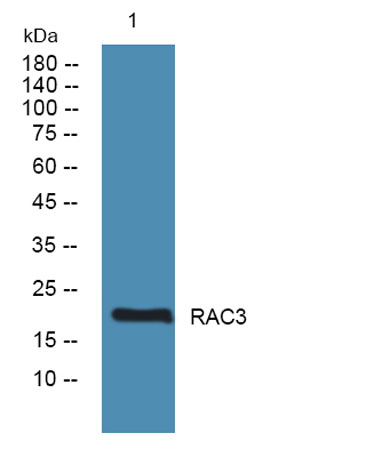
| Observed band (KD) | 21kD |
| Background | The protein encoded by this gene is a GTPase which belongs to the RAS superfamily of small GTP-binding proteins. Members of this superfamily appear to regulate a diverse array of cellular events, including the control of cell growth, cytoskeletal reorganization, and the activation of protein kinases. Alternative splicing results in multiple transcript variants. [provided by RefSeq, Oct 2015], |
| Function | function:Plasma membrane-associated small GTPase which cycles between an active GTP-bound and inactive GDP-bound state. In active state binds to a variety of effector proteins to regulate cellular responses, such as cell spreading and the formation of actin-based protusions including lamellipodia and membrane ruffles.,induction:Expression down-regulated in quiescent fibroblasts and clearly induced by serum stimulation.,similarity:Belongs to the small GTPase superfamily. Rho family.,subcellular location:Membrane-associated when activated. Co-localizes with NRBP to endomembranes and at the cell periphery in lamellipodia.,subunit:Interacts with the GEF protein DOCK7, which promotes the exchange between GDP and GTP, and therefore activates it. Interacts with C1D.,tissue specificity:Highest levels in brain, also detected in heart, placenta and pancreas., |
| Subcellular location | Cytoplasm. Endomembrane system. Cell projection, lamellipodium. Cytoplasm, perinuclear region. Cell membrane. Cytoplasm, cytoskeleton. Membrane-associated when activated. Colocalizes with NRBP to endomembranes and at the cell periphery in lamellipodia. Colocalized with CIB1 in the perinuclear area and at the cell periphery. |
| Expression | Highest levels in brain, also detected in heart, placenta and pancreas. |

Use collapsible tabs for more detailed information that will help customers make a purchasing decision.
Ex: Shipping and return policies, size guides, and other common questions.