 Français
 English

| ELK.No | ES1015 |
| Product name | Caspase-14 rabbit pAb |
| Reactivity | Human;Rat;Mouse; |
| Applications | WB;ELISA |
| Other name | CASP14; Caspase-14; CASP-14 |
| Size | 50μL |
| Unit price ($) | 148 |
| Human gene ID | 23581 |
| Human Swiss-Prot | P31944 |
| Source | Rabbit |
| Isotype | IgG |
| Target | Caspase-14 |
| Fields | |
| Gene name | CASP14 |
| Protein name | Caspase14 |
| Human gene link | View Human Gene |
| Human Swiss link | View Human Swiss-Prot |
| Mouse gene ID | |
| Mouse gene link | |
| Mouse Swiss-Prot | O89094 |
| Mouse Swiss link | View Mouse Swiss-Prot |
| Rat gene ID | |
| Rat gene link | |
| Rat Swiss-Prot | |
| Rat Swiss link | |
| Immunogen | Synthesized peptide derived from Caspase-14 . at AA range: 110-190 |
| Specificity | Caspase-14 Polyclonal Antibody detects endogenous levels of Caspase-14 protein. |
| Formulation | Liquid in PBS containing 50% glycerol, 0.5% BSA and 0.02% sodium azide. |
| Clonality | Polyclonal |
| Dilution | Western Blot: 1/500 - 1/2000. ELISA: 1/40000. Not yet tested in other applications. |
| Purification | The antibody was affinity-purified from rabbit antiserum by affinity-chromatography using epitope-specific immunogen. |
| Concentration | 1 mg/ml |
| Storage stability | -20°C/1 year |
| Molecular Weight (Da) | |
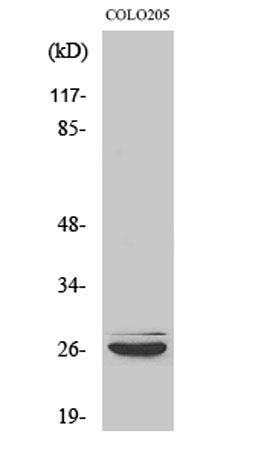
| Observed band (KD) | 27kD |
| Background | This gene encodes a member of the cysteine-aspartic acid protease (caspase) family. Sequential activation of caspases plays a central role in the execution-phase of cell apoptosis. Caspases exist as inactive proenzymes which undergo proteolytic processing at conserved aspartic residues to produce two subunits, large and small, that dimerize to form the active enzyme. This caspase has been shown to be processed and activated by caspase 8 and caspase 10 in vitro, and by anti-Fas agonist antibody or TNF-related apoptosis inducing ligand in vivo. The expression and processing of this caspase may be involved in keratinocyte terminal differentiation, which is important for the formation of the skin barrier. [provided by RefSeq, Jul 2008], |
| Function | function:Believed to be a non-apoptotic caspase which is involved in epidermal differentiation. Seems to play a role in keratinocyte differentiation and cornification. Probably regulates maturation of the epidermis by proteolytically processing filaggrin.,induction:In undifferentiated keratinocytes under postconfluency growth conditions (in vitro).,similarity:Belongs to the peptidase C14A family.,subunit:Complex of unprocessed caspase-14 and processed 19 kDa (p19) and 10 kDa (p10) subunits.,tissue specificity:Expressed in kerotinocytes of adult skin suprabasal layers (from spinous layers to the stratum granulosum and stratum corneum) (at protein level). Expressed in keratinocytes of hair shaft and sebaceous glands (at protein level). In psoriatic skin only expressed at very low levels., |
| Subcellular location | Cytoplasm . Nucleus . |
| Expression | Expressed in keratinocytes of adult skin suprabasal layers (from spinous layers to the stratum granulosum and stratum corneum) (at protein level). Expressed in keratinocytes of hair shaft and sebaceous glands (at protein level). In psoriatic skin only expressed at very low levels (PubMed:11175259). The p17/10 mature form is expressed in epidermis stratum corneum, the p20/p8 intermediate form in epidermis upper granular cells of the stratum granulosum (PubMed:22825846). |

Use collapsible tabs for more detailed information that will help customers make a purchasing decision.
Ex: Shipping and return policies, size guides, and other common questions.