 Français
 English
Cleaved-Cathepsin D HC (L169) rabbit pAb
AO-06-ES1026-100

| ELK.No | ES1026 |
| Product name | Cleaved-Cathepsin D HC (L169) rabbit pAb |
| Reactivity | Human;Rat;Mouse; |
| Applications | WB;ELISA |
| Other name | CTSD; CPSD; Cathepsin D |
| Size | 100μL |
| Unit price ($) | 248 |
| Human gene ID | 1509 |
| Human Swiss-Prot | P07339 |
| Source | Rabbit |
| Isotype | IgG |
| Target | Cathepsin D |
| Fields | >>Sphingolipid signaling pathway;>>Autophagy - animal;>>Lysosome;>>Apoptosis;>>Estrogen signaling pathway;>>Tuberculosis;>>Diabetic cardiomyopathy |
| Gene name | CTSD |
| Protein name | Cathepsin D |
| Human gene link | View Human Gene |
| Human Swiss link | View Human Swiss-Prot |
| Mouse gene ID | |
| Mouse gene link | |
| Mouse Swiss-Prot | P18242 |
| Mouse Swiss link | View Mouse Swiss-Prot |
| Rat gene ID | |
| Rat gene link | |
| Rat Swiss-Prot | |
| Rat Swiss link | |
| Immunogen | The antiserum was produced against synthesized peptide derived from human CATD. AA range:150-199 |
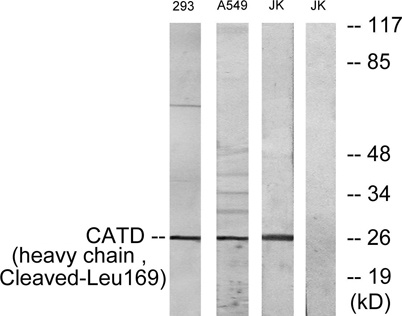
| Specificity | Cleaved-Cathepsin D HC (L169) Polyclonal Antibody detects endogenous levels of fragment of activated Cathepsin D HC protein resulting from cleavage adjacent to L169. |
| Formulation | Liquid in PBS containing 50% glycerol, 0.5% BSA and 0.02% sodium azide. |
| Clonality | Polyclonal |
| Dilution | Western Blot: 1/500 - 1/2000. ELISA: 1/40000. Not yet tested in other applications. |
| Purification | The antibody was affinity-purified from rabbit antiserum by affinity-chromatography using epitope-specific immunogen. |
| Concentration | 1 mg/ml |
| Storage stability | -20°C/1 year |
| Molecular Weight (Da) | |
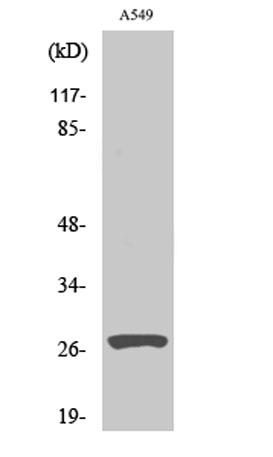
| Observed band (KD) | 27kD |
| Background | This gene encodes a member of the A1 family of peptidases. The encoded preproprotein is proteolytically processed to generate multiple protein products. These products include the cathepsin D light and heavy chains, which heterodimerize to form the mature enzyme. This enzyme exhibits pepsin-like activity and plays a role in protein turnover and in the proteolytic activation of hormones and growth factors. Mutations in this gene play a causal role in neuronal ceroid lipofuscinosis-10 and may be involved in the pathogenesis of several other diseases, including breast cancer and possibly Alzheimer's disease. [provided by RefSeq, Nov 2015], |
| Function | catalytic activity:Specificity similar to, but narrower than, that of pepsin A. Does not cleave the 4-Gln-|-His-5 bond in B chain of insulin.,disease:Defects in CTSD are the cause of neuronal ceroid lipofuscinosis 10 (CLN10) [MIM:610127]; also known as neuronal ceroid lipofuscinosis due to cathepsin D deficiency. The neuronal ceroid lipofuscinosis are a group of progressive neurodegenerative diseases in children and in adults, characterized by visual and mental decline, motor disturbance, epilepsy and behavioral changes.,function:Acid protease active in intracellular protein breakdown. Involved in the pathogenesis of several diseases such as breast cancer and possibly Alzheimer disease.,polymorphism:The Val-58 allele is significantly overrepresented in demented patients (11.8%) compared with non-demented controls (4.9%). Carriers of the Val-58 allele have a 3.1-fold increased risk for de |
| Subcellular location | Lysosome. Melanosome. Secreted, extracellular space. Identified by mass spectrometry in melanosome fractions from stage I to stage IV. In aortic samples, detected as an extracellular protein loosely bound to the matrix (PubMed:20551380). . |
| Expression | Expressed in the aorta extracellular space (at protein level) (PubMed:20551380). Expressed in liver (at protein level) (PubMed:1426530). |

Use collapsible tabs for more detailed information that will help customers make a purchasing decision.
Ex: Shipping and return policies, size guides, and other common questions.