 Français
 English
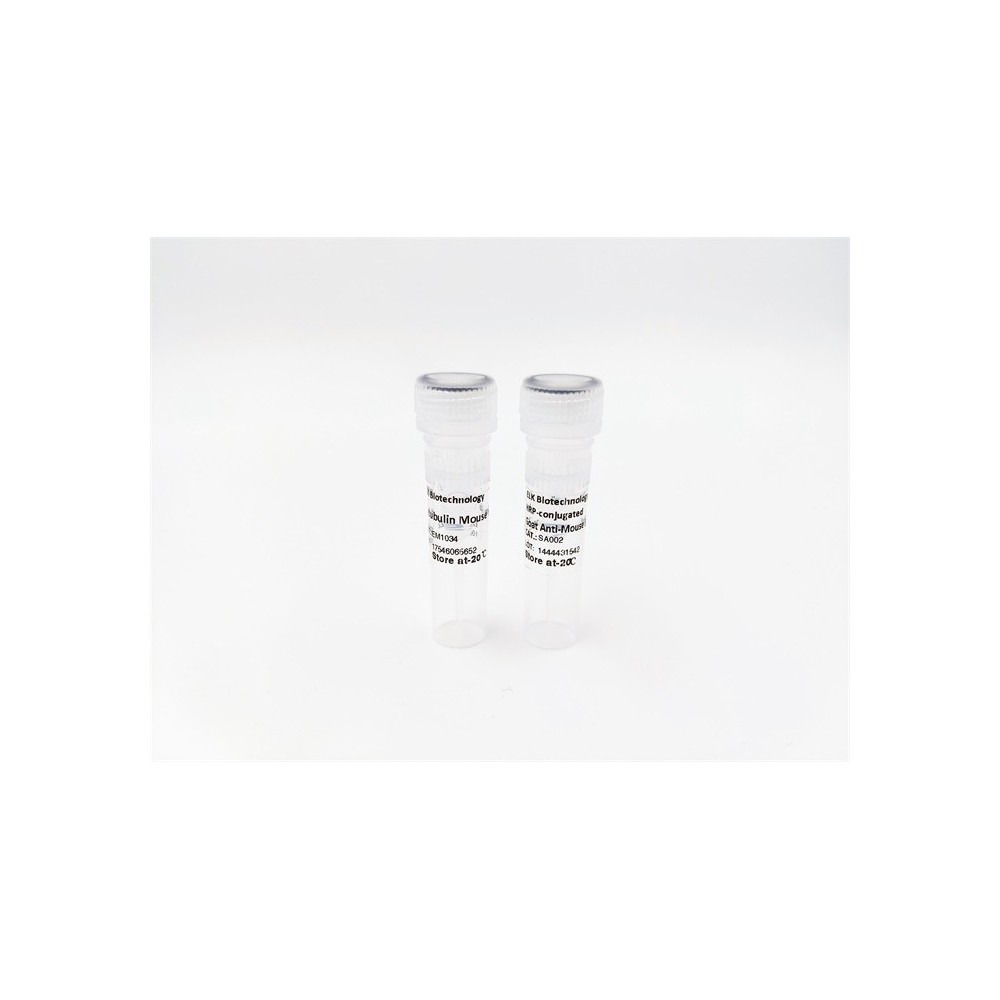

| ELK.No | ES10264 |
| Product name | CCL13 rabbit pAb |
| Reactivity | Human;Rat;Mouse; |
| Applications | WB;ELISA |
| Other name | |
| Size | 50μL |
| Unit price ($) | 148 |
| Human gene ID | 6357 |
| Human Swiss-Prot | Q99616 |
| Source | Rabbit |
| Isotype | IgG |
| Target | CCL13 |
| Fields | >>Cytokine-cytokine receptor interaction;>>Viral protein interaction with cytokine and cytokine receptor;>>Chemokine signaling pathway;>>NF-kappa B signaling pathway |
| Gene name | CCL13 MCP4 NCC1 SCYA13 |
| Protein name | C-C motif chemokine 13 (CK-beta-10) (Monocyte chemoattractant protein 4) (Monocyte chemotactic protein 4) (MCP-4) (NCC-1) (Small-inducible cytokine A13) [Cleaved into: C-C motif chemokine 13, long cha |
| Human gene link | |
| Human Swiss link | View Human Swiss-Prot |
| Mouse gene ID | |
| Mouse gene link | |
| Mouse Swiss-Prot | |
| Mouse Swiss link | |
| Rat gene ID | |
| Rat gene link | |
| Rat Swiss-Prot | |
| Rat Swiss link | |
| Immunogen | Synthesized peptide derived from human protein . at AA range: 20-100 |
| Specificity | CCL13 Polyclonal Antibody detects endogenous levels of protein. |
| Formulation | Liquid in PBS containing 50% glycerol, and 0.02% sodium azide. |
| Clonality | Polyclonal |
| Dilution | WB 1:500-2000 ELISA 1:5000-20000 |
| Purification | The antibody was affinity-purified from rabbit antiserum by affinity-chromatography using epitope-specific immunogen. |
| Concentration | 1 mg/ml |
| Storage stability | -20°C/1 year |
| Molecular Weight (Da) | |
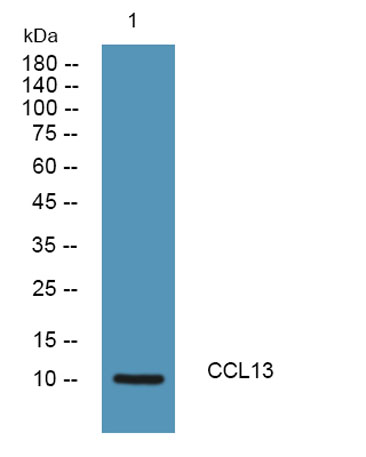
| Observed band (KD) | 10kD |
| Background | This antimicrobial gene is one of several Cys-Cys (CC) cytokine genes clustered on the q-arm of chromosome 17. Cytokines are a family of secreted proteins involved in immunoregulatory and inflammatory processes. The CC cytokines are proteins characterized by two adjacent cysteines. The cytokine encoded by this gene displays chemotactic activity for monocytes, lymphocytes, basophils and eosinophils, but not neutrophils. This chemokine plays a role in accumulation of leukocytes during inflammation. It may also be involved in the recruitment of monocytes into the arterial wall during artherosclerosis. [provided by RefSeq, Sep 2014], |
| Function | function:Chemotactic factor that attracts monocytes, lymphocytes, basophils and eosinophils, but not neutrophils. Signals through CCR2B and CCR3 receptors. Plays a role in the accumulation of leukocytes at both sides of allergic and non-allergic inflammation. May be involved in the recruitment of monocytes into the arterial wall during the disease process of atherosclerosis. May play a role in the monocyte attraction in tissues chronically exposed to exogenous pathogens.,induction:By interleukin-1 and TNF-alpha.,mass spectrometry: PubMed:8642349,miscellaneous:This protein can bind heparin.,online information:CCL13 entry,PTM:One major form (form long), and two minor forms (short chain and medium chain) are produced by differential signal peptide cleavage. The medium chain is about 30-fold less active than the long chain.,similarity:Belongs to the intercrine beta (chemokine CC) family.,tis |
| Subcellular location | Secreted. |
| Expression | Widely expressed. Found in small intestine, thymus, colon, lung, trachea, stomach and lymph node. Low levels seen in the pulmonary artery smooth muscle cells. |

Use collapsible tabs for more detailed information that will help customers make a purchasing decision.
Ex: Shipping and return policies, size guides, and other common questions.