 Français
 English
Cleaved-MMP-12 (G106) rabbit pAb
AO-06-ES1043-100

| ELK.No | ES1043 |
| Product name | Cleaved-MMP-12 (G106) rabbit pAb |
| Reactivity | Human;Rat;Mouse; |
| Applications | WB;ELISA |
| Other name | MMP12; HME; Macrophage metalloelastase; MME; Macrophage elastase; ME; hME; Matrix metalloproteinase-12; MMP-12 |
| Size | 100μL |
| Unit price ($) | 248 |
| Human gene ID | 4321 |
| Human Swiss-Prot | P39900 |
| Source | Rabbit |
| Isotype | IgG |
| Target | MMP-12 |
| Fields | |
| Gene name | MMP12 |
| Protein name | Macrophage metalloelastase |
| Human gene link | View Human Gene |
| Human Swiss link | View Human Swiss-Prot |
| Mouse gene ID | |
| Mouse gene link | |
| Mouse Swiss-Prot | P34960 |
| Mouse Swiss link | View Mouse Swiss-Prot |
| Rat gene ID | |
| Rat gene link | |
| Rat Swiss-Prot | |
| Rat Swiss link | |
| Immunogen | The antiserum was produced against synthesized peptide derived from human MMP12. AA range:87-136 |
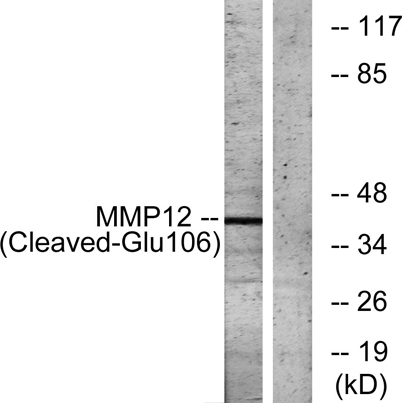
| Specificity | Cleaved-MMP-12 (G106) Polyclonal Antibody detects endogenous levels of fragment of activated MMP-12 protein resulting from cleavage adjacent to G106. |
| Formulation | Liquid in PBS containing 50% glycerol, 0.5% BSA and 0.02% sodium azide. |
| Clonality | Polyclonal |
| Dilution | Western Blot: 1/500 - 1/2000. ELISA: 1/20000. Not yet tested in other applications. |
| Purification | The antibody was affinity-purified from rabbit antiserum by affinity-chromatography using epitope-specific immunogen. |
| Concentration | 1 mg/ml |
| Storage stability | -20°C/1 year |
| Molecular Weight (Da) | |
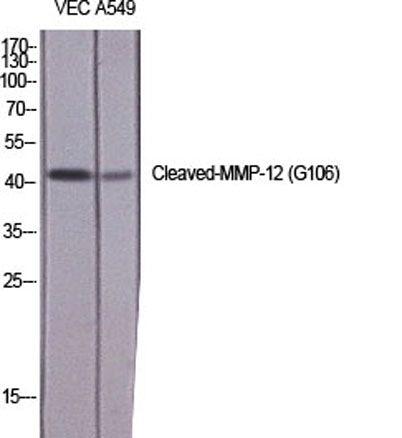
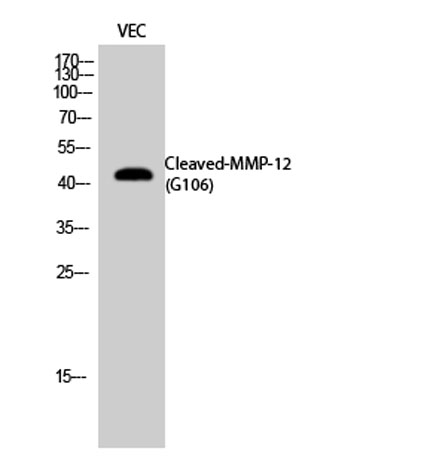
| Observed band (KD) | 42kD |
| Background | This gene encodes a member of the peptidase M10 family of matrix metalloproteinases (MMPs). Proteins in this family are involved in the breakdown of extracellular matrix in normal physiological processes, such as embryonic development, reproduction, and tissue remodeling, as well as in disease processes, such as arthritis and metastasis. The encoded preproprotein is proteolytically processed to generate the mature protease. This protease degrades soluble and insoluble elastin. This gene may play a role in aneurysm formation and mutations in this gene are associated with lung function and chronic obstructive pulmonary disease (COPD). This gene is part of a cluster of MMP genes on chromosome 11. [provided by RefSeq, Jan 2016], |
| Function | catalytic activity:Hydrolysis of soluble and insoluble elastin. Specific cleavages are also produced at 14-Ala-|-Leu-15 and 16-Tyr-|-Leu-17 in the B chain of insulin.,cofactor:Binds 2 zinc ions per subunit.,cofactor:Binds 4 calcium ions per subunit.,domain:The conserved cysteine present in the cysteine-switch motif binds the catalytic zinc ion, thus inhibiting the enzyme. The dissociation of the cysteine from the zinc ion upon the activation-peptide release activates the enzyme.,function:May be involved in tissue injury and remodeling. Has significant elastolytic activity. Can accept large and small amino acids at the P1' site, but has a preference for leucine. Aromatic or hydrophobic residues are preferred at the P1 site, with small hydrophobic residues (preferably alanine) occupying P3.,induction:By exposure to lipopolysaccharide. Inhibited by dexamethasone.,similarity:Belongs to the p |
| Subcellular location | Secreted, extracellular space, extracellular matrix . |
| Expression | Found in alveolar macrophages but not in peripheral blood monocytes. |

Use collapsible tabs for more detailed information that will help customers make a purchasing decision.
Ex: Shipping and return policies, size guides, and other common questions.