 Français
 English

| ELK.No | ES1061 |
| Product name | HABP2 rabbit pAb |
| Reactivity | Human;Mouse;Rat |
| Applications | WB;ELISA |
| Other name | HABP2; HGFAL; PHBP; Hyaluronan-binding protein 2; Factor VII-activating protease; Factor seven-activating protease; FSAP; Hepatocyte growth factor activator-like protein; Plasma hyaluronan-binding protein |
| Size | 100μL |
| Unit price ($) | 248 |
| Human gene ID | 3026 |
| Human Swiss-Prot | Q14520 |
| Source | Rabbit |
| Isotype | IgG |
| Target | HABP2 |
| Fields | |
| Gene name | HABP2 |
| Protein name | Hyaluronan-binding protein 2 |
| Human gene link | View Human Gene |
| Human Swiss link | View Human Swiss-Prot |
| Mouse gene ID | 226243 |
| Mouse gene link | View Mouse Gene |
| Mouse Swiss-Prot | Q8K0D2 |
| Mouse Swiss link | View Mouse Swiss-Prot |
| Rat gene ID | 292126 |
| Rat gene link | View Rat Gene |
| Rat Swiss-Prot | Q6L711 |
| Rat Swiss link | View Rat Swiss-Prot |
| Immunogen | Synthesized peptide derived from HABP2 . at AA range: 270-350 |
| Specificity | HABP2 Polyclonal Antibody detects endogenous levels of HABP2 protein. |
| Formulation | Liquid in PBS containing 50% glycerol, 0.5% BSA and 0.02% sodium azide. |
| Clonality | Polyclonal |
| Dilution | Western Blot: 1/500 - 1/2000. ELISA: 1/5000. Not yet tested in other applications. |
| Purification | The antibody was affinity-purified from rabbit antiserum by affinity-chromatography using epitope-specific immunogen. |
| Concentration | 1 mg/ml |
| Storage stability | -20°C/1 year |
| Molecular Weight (Da) | |
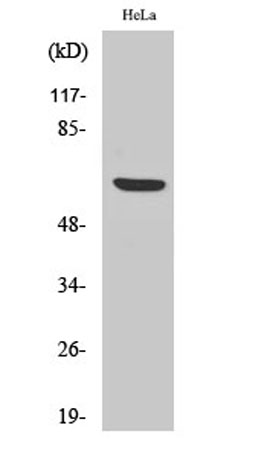
| Observed band (KD) | 63kD |
| Background | This gene encodes a member of the peptidase S1 family of serine proteases. The encoded preproprotein is secreted by hepatocytes and proteolytically processed to generate heavy and light chains that form the mature heterodimer. Further autoproteolysis leads to smaller, inactive peptides. This extracellular protease binds hyaluronic acid and may play a role in the coagulation and fibrinolysis systems. Mutations in this gene are associated with nonmedullary thyroid cancer and susceptibility to venous thromboembolism. Alternative splicing results in multiple transcript variants, at least one of which encodes a preproprotein that is proteolytically processed. [provided by RefSeq, Jan 2016], |
| Function | function:Cleaves the alpha-chain at multiple sites and the beta-chain between 'Lys-53' and 'Lys-54' but not the gamma-chain of fibrinogen and therefore does not initiate the formation of the fibrin clot and does not cause the fibrinolysis directly. It does not cleave (activate) prothrombin and plasminogen but converts the inactive single chain urinary plasminogen activator (pro-urokinase) to the active two chain form. Activates coagulation factor VII.,PTM:Proteolytic cleavage at Gly-23 or Met-27 can give rise to the 50 kDa heavy chain and cleavage at Arg-313 or Lys-319 can give rise to the 27 kDa light chain. The heavy chain can undergo further proteolytic cleavage at Lys-169 or Arg-170 to give rise to 2 inactive 26 kDa fragments and the light chain can undergo further proteolytic cleavage at Arg-480 to give rise to inactive 17 kDa and 8 kDa fragments.,similarity:Belongs to the peptidase |
| Subcellular location | Secreted . Secreted as an inactive single-chain precursor and is then activated to a heterodimeric form. |
| Expression | Ubiquitously expressed. |

Use collapsible tabs for more detailed information that will help customers make a purchasing decision.
Ex: Shipping and return policies, size guides, and other common questions.