 Français
 English

| ELK.No | ES10647 |
| Product name | WWTR1 rabbit pAb |
| Reactivity | Human;Mouse |
| Applications | WB;ELISA |
| Other name | |
| Size | 50μL |
| Unit price ($) | 148 |
| Human gene ID | 25937 |
| Human Swiss-Prot | Q9GZV5 |
| Source | Rabbit |
| Isotype | IgG |
| Target | WWTR1 |
| Fields | >>Hippo signaling pathway;>>Hippo signaling pathway - multiple species |
| Gene name | WWTR1 TAZ |
| Protein name | WW domain-containing transcription regulator protein 1 (Transcriptional coactivator with PDZ-binding motif) |
| Human gene link | |
| Human Swiss link | View Human Swiss-Prot |
| Mouse gene ID | |
| Mouse gene link | |
| Mouse Swiss-Prot | Q9EPK5 |
| Mouse Swiss link | View Mouse Swiss-Prot |
| Rat gene ID | |
| Rat gene link | |
| Rat Swiss-Prot | |
| Rat Swiss link | |
| Immunogen | Synthesized peptide derived from part region of human protein |
| Specificity | WWTR1 Polyclonal Antibody detects endogenous levels of protein. |
| Formulation | Liquid in PBS containing 50% glycerol, and 0.02% sodium azide. |
| Clonality | Polyclonal |
| Dilution | WB 1:500-2000 ELISA 1:5000-20000 |
| Purification | The antibody was affinity-purified from rabbit antiserum by affinity-chromatography using epitope-specific immunogen. |
| Concentration | 1 mg/ml |
| Storage stability | -20°C/1 year |
| Molecular Weight (Da) | |
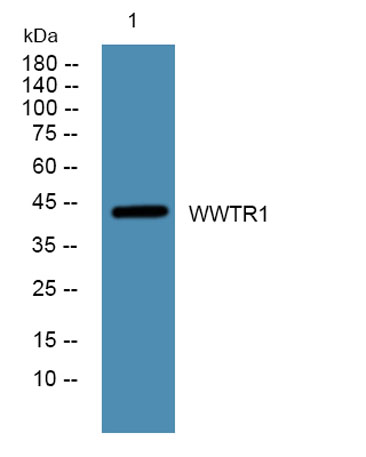
| Observed band (KD) | 44kD |
| Background | domain:Binds to transcription factors via its WW domain.,domain:The PDZ-binding motif is essential for stimulated gene transcription. It localizes the protein into both punctate nuclear foci and plasma membrane-associated complexes.,function:Functions as a transcriptional coactivator.,PTM:Phosphorylated. Phosphorylation results in the inhibition of transcriptional coactivation through YWHAZ-mediated nuclear export.,similarity:Contains 1 WW domain.,subcellular location:Concentrates along specific portions of the plasma membrane, and accumulates in punctate nuclear bodies. When phosphorylated, is retained in cytoplasm by YWHAZ.,subunit:Binds to SLC9A3R2 via the PDZ motif at the plasma membrane. Binds to YWHAZ in vivo and in vitro through the phosphoserine-binding motif RSHSSP.,tissue specificity:Highly expressed in kidney, heart, placenta and lung., |
| Function | domain:Binds to transcription factors via its WW domain.,domain:The PDZ-binding motif is essential for stimulated gene transcription. It localizes the protein into both punctate nuclear foci and plasma membrane-associated complexes.,function:Functions as a transcriptional coactivator.,PTM:Phosphorylated. Phosphorylation results in the inhibition of transcriptional coactivation through YWHAZ-mediated nuclear export.,similarity:Contains 1 WW domain.,subcellular location:Concentrates along specific portions of the plasma membrane, and accumulates in punctate nuclear bodies. When phosphorylated, is retained in cytoplasm by YWHAZ.,subunit:Binds to SLC9A3R2 via the PDZ motif at the plasma membrane. Binds to YWHAZ in vivo and in vitro through the phosphoserine-binding motif RSHSSP.,tissue specificity:Highly expressed in kidney, heart, placenta and lung., |
| Subcellular location | Nucleus . Cytoplasm . Cell membrane . Concentrates along specific portions of the plasma membrane, and accumulates in punctate nuclear bodies (By similarity). When phosphorylated, is retained in the cytoplasm by YWHAZ (By similarity). Can be retained in the nucleus by MED15 (PubMed:18568018). Localized in the cytoplasm in areas of epithelial cell high density (PubMed:21145499). At blastocyst stage expressed in the nucleus in trophectodermal cells, however expressed in the cytoplasm in the inner cell mass (By similarity). . |
| Expression | Highly expressed in kidney, heart, placenta and lung. Expressed in the thyroid tissue. |

Use collapsible tabs for more detailed information that will help customers make a purchasing decision.
Ex: Shipping and return policies, size guides, and other common questions.