 Français
 English
Cleaved-Plasminogen HC A short form (V98) rabbit pAb
AO-06-ES1073-50

| ELK.No | ES1073 |
| Product name | Cleaved-Plasminogen HC A short form (V98) rabbit pAb |
| Reactivity | Human;Mouse;Rat |
| Applications | WB;ELISA |
| Other name | PLG; Plasminogen |
| Size | 50μL |
| Unit price ($) | 148 |
| Human gene ID | 5340 |
| Human Swiss-Prot | P00747 |
| Source | Rabbit |
| Isotype | IgG |
| Target | Plasminogen HC A |
| Fields | >>Neuroactive ligand-receptor interaction;>>Complement and coagulation cascades;>>Staphylococcus aureus infection;>>Influenza A |
| Gene name | PLG |
| Protein name | Plasminogen |
| Human gene link | View Human Gene |
| Human Swiss link | View Human Swiss-Prot |
| Mouse gene ID | 18815 |
| Mouse gene link | View Mouse Gene |
| Mouse Swiss-Prot | P20918 |
| Mouse Swiss link | View Mouse Swiss-Prot |
| Rat gene ID | 85253 |
| Rat gene link | View Rat Gene |
| Rat Swiss-Prot | Q01177 |
| Rat Swiss link | View Rat Swiss-Prot |
| Immunogen | The antiserum was produced against synthesized peptide derived from human PLMN. AA range:79-128 |
| Specificity | Cleaved-Plasminogen HC A short form (V98) Polyclonal Antibody detects endogenous levels of fragment of activated Plasminogen HC A short form protein resulting from cleavage adjacent to V98. |
| Formulation | Liquid in PBS containing 50% glycerol, 0.5% BSA and 0.02% sodium azide. |
| Clonality | Polyclonal |
| Dilution | Western Blot: 1/500 - 1/2000. ELISA: 1/10000. Not yet tested in other applications. |
| Purification | The antibody was affinity-purified from rabbit antiserum by affinity-chromatography using epitope-specific immunogen. |
| Concentration | 1 mg/ml |
| Storage stability | -20°C/1 year |
| Molecular Weight (Da) | |
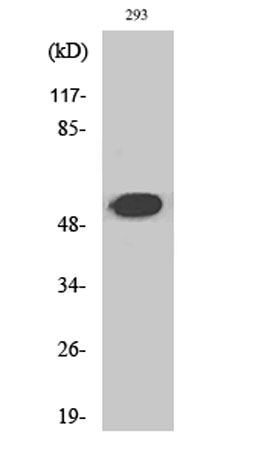
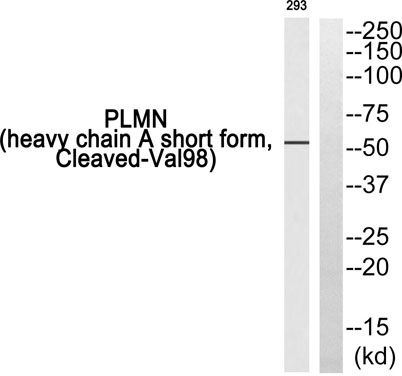
| Observed band (KD) | 54kD |
| Background | The protein encoded by this gene is a secreted blood zymogen that is activated by proteolysis and converted to plasmin and angiostatin. Plasmin dissolves fibrin in blood clots and is an important protease in many other cellular processes while angiostatin inhibits angiogenesis. Defects in this gene are likely a cause of thrombophilia and ligneous conjunctivitis. Two transcript variants encoding different isoforms have been found for this gene.[provided by RefSeq, Dec 2009], |
| Function | catalytic activity:Preferential cleavage: Lys-|-Xaa > Arg-|-Xaa; higher selectivity than trypsin. Converts fibrin into soluble products.,disease:Defects in PLG are a cause of thrombophilia [MIM:188050]; a form of recurrent thrombosis.,disease:Defects in PLG may be associated with ligneous conjunctivitis [MIM:217090]. Ligneous conjunctivitis is an unusual and rare form of chronic conjunctivitis, characterized by chronic tearing and redness of the conjunctivae. Initially, pseudomembranes form on the palpebral surfaces which then progress to thick nodular masses that replace the normal mucosa. Because the pseudomembranes have a woodlike consistency, the disease is termed "ligneous" conjunctivitis. The disease may be associated with pseudomembranous lesions of other mucous membranes in the mouth, nasopharynx, trachea, and female genital tract.,domain:Kringle domains mediate interaction with |
| Subcellular location | Secreted . Locates to the cell surface where it is proteolytically cleaved to produce the active plasmin. Interaction with HRG tethers it to the cell surface. |
| Expression | Present in plasma and many other extracellular fluids. It is synthesized in the liver. |

Use collapsible tabs for more detailed information that will help customers make a purchasing decision.
Ex: Shipping and return policies, size guides, and other common questions.