 Français
 English

| ELK.No | ES10732 |
| Product name | PK1IP rabbit pAb |
| Reactivity | Human;Rat;Mouse; |
| Applications | WB;ELISA |
| Other name | |
| Size | 100μL |
| Unit price ($) | 248 |
| Human gene ID | 55003 |
| Human Swiss-Prot | Q9NWT1 |
| Source | Rabbit |
| Isotype | IgG |
| Target | PK1IP |
| Fields | |
| Gene name | PAK1IP1 PIP1 WDR84 |
| Protein name | p21-activated protein kinase-interacting protein 1 (PAK/PLC-interacting protein 1) (hPIP1) (PAK1-interacting protein 1) (WD repeat-containing protein 84) |
| Human gene link | |
| Human Swiss link | View Human Swiss-Prot |
| Mouse gene ID | |
| Mouse gene link | |
| Mouse Swiss-Prot | Q9DCE5 |
| Mouse Swiss link | View Mouse Swiss-Prot |
| Rat gene ID | |
| Rat gene link | |
| Rat Swiss-Prot | |
| Rat Swiss link | |
| Immunogen | Synthesized peptide derived from part region of human protein |
| Specificity | PK1IP Polyclonal Antibody detects endogenous levels of protein. |
| Formulation | Liquid in PBS containing 50% glycerol, and 0.02% sodium azide. |
| Clonality | Polyclonal |
| Dilution | WB 1:500-2000 ELISA 1:5000-20000 |
| Purification | The antibody was affinity-purified from rabbit antiserum by affinity-chromatography using epitope-specific immunogen. |
| Concentration | 1 mg/ml |
| Storage stability | -20°C/1 year |
| Molecular Weight (Da) | |
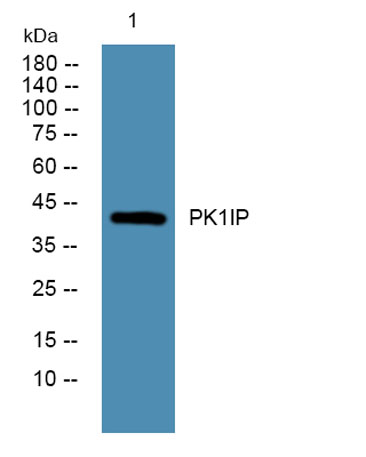
| Observed band (KD) | 43kD |
| Background | function:Negatively regulates the PAK1 kinase. PAK1 is a member of the PAK kinase family, which have been shown to play a positive role in the regulation of signaling pathways involving MAPK8 and RELA. PAK1 exists as an inactive homodimer, which is activated by binding of small GTPases such as CDC42 to an N-terminal regulatory domain. PAK1IP1 also binds to the N-terminus of PAK1, and inhibits the specific activation of PAK1 by CDC42.,similarity:Contains 5 WD repeats.,subunit:Interacts with PAK1.,tissue specificity:Expressed in brain, colon, heart, kidney, liver, lung, muscle, peripheral blood leukocytes, placenta, small intestine, spleen and thymus., |
| Function | function:Negatively regulates the PAK1 kinase. PAK1 is a member of the PAK kinase family, which have been shown to play a positive role in the regulation of signaling pathways involving MAPK8 and RELA. PAK1 exists as an inactive homodimer, which is activated by binding of small GTPases such as CDC42 to an N-terminal regulatory domain. PAK1IP1 also binds to the N-terminus of PAK1, and inhibits the specific activation of PAK1 by CDC42.,similarity:Contains 5 WD repeats.,subunit:Interacts with PAK1.,tissue specificity:Expressed in brain, colon, heart, kidney, liver, lung, muscle, peripheral blood leukocytes, placenta, small intestine, spleen and thymus., |
| Subcellular location | Nucleus, nucleolus . |
| Expression | Expressed in brain, colon, heart, kidney, liver, lung, muscle, peripheral blood leukocytes, placenta, small intestine, spleen and thymus. |

Use collapsible tabs for more detailed information that will help customers make a purchasing decision.
Ex: Shipping and return policies, size guides, and other common questions.