 Français
 English

| ELK.No | ES10791 |
| Product name | ING2 rabbit pAb |
| Reactivity | Human;Mouse |
| Applications | WB;ELISA |
| Other name | |
| Size | 100μL |
| Unit price ($) | 248 |
| Human gene ID | 3622 |
| Human Swiss-Prot | Q9H160 |
| Source | Rabbit |
| Isotype | IgG |
| Target | ING2 |
| Fields | |
| Gene name | ING2 ING1L |
| Protein name | Inhibitor of growth protein 2 (Inhibitor of growth 1-like protein) (ING1Lp) (p32) (p33ING2) |
| Human gene link | |
| Human Swiss link | View Human Swiss-Prot |
| Mouse gene ID | |
| Mouse gene link | |
| Mouse Swiss-Prot | Q9ESK4 |
| Mouse Swiss link | View Mouse Swiss-Prot |
| Rat gene ID | |
| Rat gene link | |
| Rat Swiss-Prot | |
| Rat Swiss link | |
| Immunogen | Synthesized peptide derived from part region of human protein |
| Specificity | ING2 Polyclonal Antibody detects endogenous levels of protein. |
| Formulation | Liquid in PBS containing 50% glycerol, and 0.02% sodium azide. |
| Clonality | Polyclonal |
| Dilution | WB 1:500-2000 ELISA 1:5000-20000 |
| Purification | The antibody was affinity-purified from rabbit antiserum by affinity-chromatography using epitope-specific immunogen. |
| Concentration | 1 mg/ml |
| Storage stability | -20°C/1 year |
| Molecular Weight (Da) | |
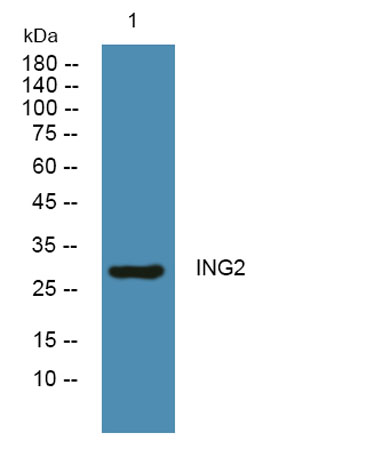
| Observed band (KD) | 30kD |
| Background | This gene is a member of the inhibitor of growth (ING) family. Members of the ING family associate with and modulate the activity of histone acetyltransferase (HAT) and histone deacetylase (HDAC) complexes and function in DNA repair and apoptosis. Alternative splicing results in multiple transcript variants. [provided by RefSeq, May 2014], |
| Function | domain:The PHD-type zinc finger domain binds to phosphoinositides (PtdInsPs), including phosphatidylinositol 5-phosphate (PtdIns(5)P).,function:Seems to be involved in p53/TP53 activation and p53/TP53-dependent apoptotic pathways, probably by enhancing acetylation of p53/TP53. Component of a mSin3A-like corepressor complex, which is probably involved in deacetylation of nucleosomal histones. ING2 activity seems to be modulated by binding to phosphoinositides (PtdInsPs).,induction:Induced by the DNA-damaging agents etoposide and neocarzinostatin.,similarity:Belongs to the ING family.,similarity:Contains 1 PHD-type zinc finger.,subcellular location:Predominantly nuclear. Localized to chromatin and nuclear matrix. Upon reduced PtdIns(5)P levels seems to be released from chromatin and, at least partially, translocated to the cytoplasm.,subunit:Component of a mSin3A-like complex at least cons |
| Subcellular location | Nucleus . Predominantly nuclear. Localized to chromatin and nuclear matrix. Upon reduced PtdIns(5)P levels seems to be released from chromatin and, at least partially, translocated to the cytoplasm. |
| Expression | Widely expressed. Higher expressed in colon-cancer tumor than in normal colon tissues. |

Use collapsible tabs for more detailed information that will help customers make a purchasing decision.
Ex: Shipping and return policies, size guides, and other common questions.