 Français
 English

| ELK.No | ES10793 |
| Product name | ING1 rabbit pAb |
| Reactivity | Human;Mouse |
| Applications | WB;ELISA |
| Other name | |
| Size | 100μL |
| Unit price ($) | 248 |
| Human gene ID | 3621 |
| Human Swiss-Prot | Q9UK53 |
| Source | Rabbit |
| Isotype | IgG |
| Target | ING1 |
| Fields | |
| Gene name | ING1 |
| Protein name | Inhibitor of growth protein 1 |
| Human gene link | |
| Human Swiss link | View Human Swiss-Prot |
| Mouse gene ID | |
| Mouse gene link | |
| Mouse Swiss-Prot | Q9QXV3 |
| Mouse Swiss link | View Mouse Swiss-Prot |
| Rat gene ID | |
| Rat gene link | |
| Rat Swiss-Prot | |
| Rat Swiss link | |
| Immunogen | Synthesized peptide derived from part region of human protein |
| Specificity | ING1 Polyclonal Antibody detects endogenous levels of protein. |
| Formulation | Liquid in PBS containing 50% glycerol, and 0.02% sodium azide. |
| Clonality | Polyclonal |
| Dilution | WB 1:500-2000 ELISA 1:5000-20000 |
| Purification | The antibody was affinity-purified from rabbit antiserum by affinity-chromatography using epitope-specific immunogen. |
| Concentration | 1 mg/ml |
| Storage stability | -20°C/1 year |
| Molecular Weight (Da) | |
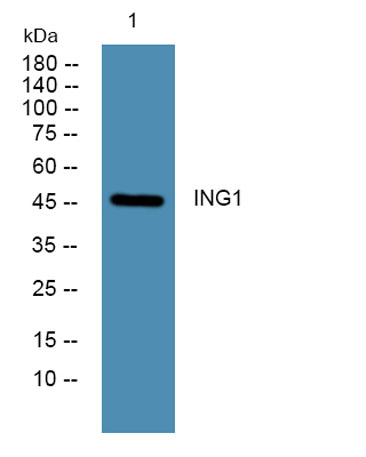
| Observed band (KD) | 46kD |
| Background | This gene encodes a tumor suppressor protein that can induce cell growth arrest and apoptosis. The encoded protein is a nuclear protein that physically interacts with the tumor suppressor protein TP53 and is a component of the p53 signaling pathway. Reduced expression and rearrangement of this gene have been detected in various cancers. Multiple alternatively spliced transcript variants encoding distinct isoforms have been reported. [provided by RefSeq, Jul 2008], |
| Function | disease:Defects in ING1 are a cause of squamous cell carcinoma of the head and neck (HNSCC) [MIM:275355].,function:Cooperates with p53/TP53 in the negative regulatory pathway of cell growth by modulating p53-dependent transcriptional activation. Implicated as a tumor suppressor gene.,similarity:Belongs to the ING family.,similarity:Contains 1 PHD-type zinc finger.,subunit:Interacts with TP53.,tissue specificity:Isoform 2 was expressed in all normal tissues and cells examined, as well as in all breast cancer and melanoma cell lines examined. Isoform 3 was expressed in testis, liver, and kidney, weakly expressed in colon and brain and not expressed in breast and cultured melanocytes. Isoform 4 was highly expressed in testis and weakly expressed in brain, but not expressed in breast, colon, kidney, melanocytes, breast cancer or melanoma cell lines., |
| Subcellular location | Nucleus . |
| Expression | Isoform 2 was expressed in all normal tissues and cells examined, as well as in all breast cancer and melanoma cell lines examined. Isoform 3 was expressed in testis, liver, and kidney, weakly expressed in colon and brain and not expressed in breast and cultured melanocytes. Isoform 4 was highly expressed in testis and weakly expressed in brain, but not expressed in breast, colon, kidney, melanocytes, breast cancer or melanoma cell lines. |

Use collapsible tabs for more detailed information that will help customers make a purchasing decision.
Ex: Shipping and return policies, size guides, and other common questions.