 Français
 English

| ELK.No | ES10846 |
| Product name | APOH rabbit pAb |
| Reactivity | Human;Rat;Mouse |
| Applications | WB;ELISA |
| Other name | |
| Size | 50μL |
| Unit price ($) | 148 |
| Human gene ID | 350 |
| Human Swiss-Prot | P02749 |
| Source | Rabbit |
| Isotype | IgG |
| Target | APOH |
| Fields | >>Cholesterol metabolism |
| Gene name | APOH B2G1 |
| Protein name | Beta-2-glycoprotein 1 (APC inhibitor) (Activated protein C-binding protein) (Anticardiolipin cofactor) (Apolipoprotein H) (Apo-H) (Beta-2-glycoprotein I) (B2GPI) (Beta(2)GPI) |
| Human gene link | |
| Human Swiss link | View Human Swiss-Prot |
| Mouse gene ID | |
| Mouse gene link | |
| Mouse Swiss-Prot | Q01339 |
| Mouse Swiss link | View Mouse Swiss-Prot |
| Rat gene ID | |
| Rat gene link | |
| Rat Swiss-Prot | P26644 |
| Rat Swiss link | View Rat Swiss-Prot |
| Immunogen | Synthesized peptide derived from part region of human protein |
| Specificity | APOH Polyclonal Antibody detects endogenous levels of protein. |
| Formulation | Liquid in PBS containing 50% glycerol, and 0.02% sodium azide. |
| Clonality | Polyclonal |
| Dilution | WB 1:500-2000 ELISA 1:5000-20000 |
| Purification | The antibody was affinity-purified from rabbit antiserum by affinity-chromatography using epitope-specific immunogen. |
| Concentration | 1 mg/ml |
| Storage stability | -20°C/1 year |
| Molecular Weight (Da) | |
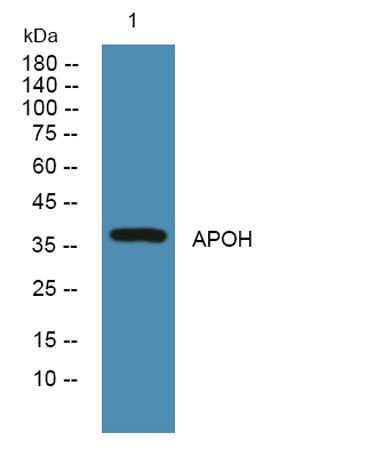
| Observed band (KD) | 37kD |
| Background | Apolipoprotein H has been implicated in a variety of physiologic pathways including lipoprotein metabolism, coagulation, and the production of antiphospholipid autoantibodies. APOH may be a required cofactor for anionic phospholipid binding by the antiphospholipid autoantibodies found in sera of many patients with lupus and primary antiphospholipid syndrome, but it does not seem to be required for the reactivity of antiphospholipid autoantibodies associated with infections. [provided by RefSeq, Jul 2008], |
| Function | function:Binds to various kinds of negatively charged substances such as heparin, phospholipids, and dextran sulfate. May prevent activation of the intrinsic blood coagulation cascade by binding to phospholipids on the surface of damaged cells.,miscellaneous:In addition to the conflicts shown in the feature table, PubMed:6587378 reports an N-glycosylation site at Asn-188.,online information:The Singapore human mutation and polymorphism database,similarity:Contains 4 Sushi (CCP/SCR) domains.,tissue specificity:Expressed by the liver and secreted in plasma., |
| Subcellular location | Secreted. |
| Expression | Expressed by the liver and secreted in plasma. |

Use collapsible tabs for more detailed information that will help customers make a purchasing decision.
Ex: Shipping and return policies, size guides, and other common questions.