 Français
 English
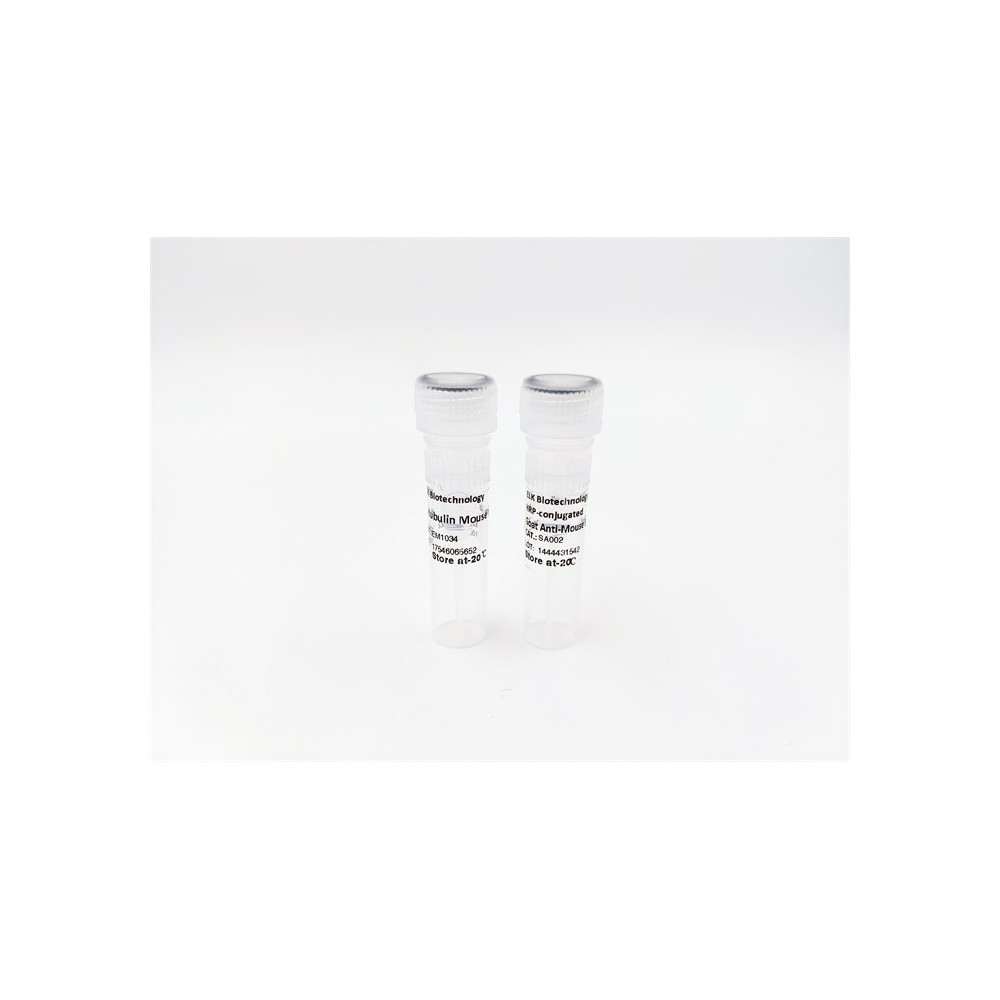

| ELK.No | ES10882 |
| Product name | ELNE rabbit pAb |
| Reactivity | Human;Mouse;Bovine;Bovine |
| Applications | WB;ELISA |
| Other name | |
| Size | 50μL |
| Unit price ($) | 148 |
| Human gene ID | 1991 |
| Human Swiss-Prot | P08246 |
| Source | Rabbit |
| Isotype | IgG |
| Target | ELNE |
| Fields | >>Neutrophil extracellular trap formation;>>Transcriptional misregulation in cancer;>>Systemic lupus erythematosus |
| Gene name | ELANE ELA2 |
| Protein name | Neutrophil elastase (EC 3.4.21.37) (Bone marrow serine protease) (Elastase-2) (Human leukocyte elastase) (HLE) (Medullasin) (PMN elastase) |
| Human gene link | |
| Human Swiss link | View Human Swiss-Prot |
| Mouse gene ID | |
| Mouse gene link | |
| Mouse Swiss-Prot | Q3UP87 |
| Mouse Swiss link | View Mouse Swiss-Prot |
| Rat gene ID | |
| Rat gene link | |
| Rat Swiss-Prot | |
| Rat Swiss link | |
| Immunogen | Synthesized peptide derived from part region of human protein |
| Specificity | ELNE Polyclonal Antibody detects endogenous levels of protein. |
| Formulation | Liquid in PBS containing 50% glycerol, and 0.02% sodium azide. |
| Clonality | Polyclonal |
| Dilution | WB 1:500-2000 ELISA 1:5000-20000 |
| Purification | The antibody was affinity-purified from rabbit antiserum by affinity-chromatography using epitope-specific immunogen. |
| Concentration | 1 mg/ml |
| Storage stability | -20°C/1 year |
| Molecular Weight (Da) | |
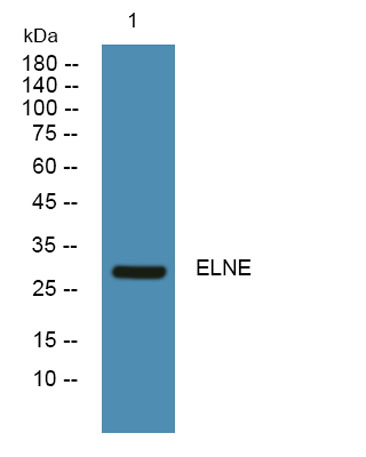
| Observed band (KD) | 29kD |
| Background | Elastases form a subfamily of serine proteases that hydrolyze many proteins in addition to elastin. Humans have six elastase genes which encode structurally similar proteins. The encoded preproprotein is proteolytically processed to generate the active protease. Following activation, this protease hydrolyzes proteins within specialized neutrophil lysosomes, called azurophil granules, as well as proteins of the extracellular matrix. The enzyme may play a role in degenerative and inflammatory diseases through proteolysis of collagen-IV and elastin. This protein also degrades the outer membrane protein A (OmpA) of E. coli as well as the virulence factors of such bacteria as Shigella, Salmonella and Yersinia. Mutations in this gene are associated with cyclic neutropenia and severe congenital neutropenia (SCN). This gene is present in a gene cluster on chromosome 19. [provided by RefSeq, Jan 2016 |
| Function | catalytic activity:Hydrolysis of proteins, including elastin. Preferential cleavage: Val-|-Xaa > Ala-|-Xaa.,disease:Defects in ELA2 are a cause of cyclic haematopoiesis (CH) [MIM:162800]; also known as cyclic neutropenia. CH is an autosomal dominant disease in which blood-cell production from the bone marrow oscillates with 21-day periodicity. Circulating neutrophils vary between almost normal numbers and zero. During intervals of neutropenia, affected individuals are at risk for opportunistic infection. Monocytes, platelets, lymphocytes and reticulocytes also cycle with the same frequency.,disease:Defects in ELA2 are the cause of autosomal dominant severe congenital neutropenia type 1 (SCN1) [MIM:202700]. Severe congenital neutropenia is a heterogeneous disorder of hematopoiesis characterized by a maturation arrest of granulopoiesis at the level of promyelocytes with peripheral blood ab |
| Subcellular location | Cytoplasmic vesicle, phagosome . Localized in phagolysosomes following ingestion of E.coli by neutrophils. . |
| Expression | Bone marrow cells. Neutrophil (PubMed:10947984). |

Use collapsible tabs for more detailed information that will help customers make a purchasing decision.
Ex: Shipping and return policies, size guides, and other common questions.