 Français
 English

| ELK.No | ES10916 |
| Product name | WISP1 rabbit pAb |
| Reactivity | Human;Rat;Mouse |
| Applications | WB;ELISA |
| Other name | |
| Size | 50μL |
| Unit price ($) | 148 |
| Human gene ID | 8840 |
| Human Swiss-Prot | O95388 |
| Source | Rabbit |
| Isotype | IgG |
| Target | WISP1 |
| Fields | >>Wnt signaling pathway |
| Gene name | WISP1 CCN4 |
| Protein name | WNT1-inducible-signaling pathway protein 1 (WISP-1) (CCN family member 4) (Wnt-1-induced secreted protein) |
| Human gene link | |
| Human Swiss link | View Human Swiss-Prot |
| Mouse gene ID | |
| Mouse gene link | |
| Mouse Swiss-Prot | O54775 |
| Mouse Swiss link | View Mouse Swiss-Prot |
| Rat gene ID | |
| Rat gene link | |
| Rat Swiss-Prot | Q99PP0 |
| Rat Swiss link | View Rat Swiss-Prot |
| Immunogen | Synthesized peptide derived from part region of human protein |
| Specificity | WISP1 Polyclonal Antibody detects endogenous levels of protein. |
| Formulation | Liquid in PBS containing 50% glycerol, and 0.02% sodium azide. |
| Clonality | Polyclonal |
| Dilution | WB 1:500-2000 ELISA 1:5000-20000 |
| Purification | The antibody was affinity-purified from rabbit antiserum by affinity-chromatography using epitope-specific immunogen. |
| Concentration | 1 mg/ml |
| Storage stability | -20°C/1 year |
| Molecular Weight (Da) | |
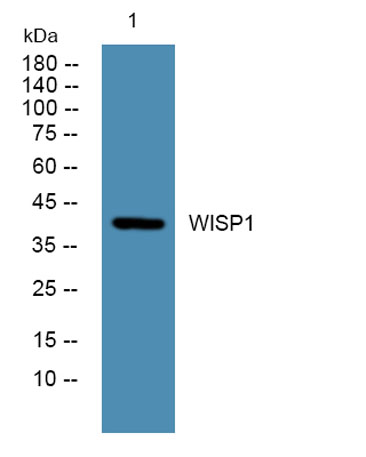
| Observed band (KD) | 40kD |
| Background | This gene encodes a member of the WNT1 inducible signaling pathway (WISP) protein subfamily, which belongs to the connective tissue growth factor (CTGF) family. WNT1 is a member of a family of cysteine-rich, glycosylated signaling proteins that mediate diverse developmental processes. The CTGF family members are characterized by four conserved cysteine-rich domains: insulin-like growth factor-binding domain, von Willebrand factor type C module, thrombospondin domain and C-terminal cystine knot-like domain. This gene may be downstream in the WNT1 signaling pathway that is relevant to malignant transformation. It is expressed at a high level in fibroblast cells, and overexpressed in colon tumors. The encoded protein binds to decorin and biglycan, two members of a family of small leucine-rich proteoglycans present in the extracellular matrix of connective tissue, and possibly pr |
| Function | function:Downstream regulator in the Wnt/Frizzled-signaling pathway. Associated with cell survival. Attenuates p53-mediated apoptosis in response to DNA damage through activation of AKT kinase. Up-regulates the anti-apoptotic Bcl-X(L) protein. Adheres to skin and melanoma fibroblasts. In vitro binding to skin fibroblasts occurs through the proteoglycans, decorin and biglycan.,similarity:Belongs to the CCN family.,similarity:Contains 1 CTCK (C-terminal cystine knot-like) domain.,similarity:Contains 1 IGFBP N-terminal domain.,similarity:Contains 1 TSP type-1 domain.,similarity:Contains 1 VWFC domain.,tissue specificity:Expressed in heart, kidney, lung, pancreas, placenta, ovary, small intestine and spleen. Isoform 2 is expressed predominantly in scirrhous gastric carcinoma and, weakly in placenta. Overexpression is associated with several cancers including breast cancer and colon tumors. I |
| Subcellular location | Secreted. |
| Expression | Expressed in heart, kidney, lung, pancreas, placenta, ovary, small intestine and spleen. Isoform 2 is expressed predominantly in scirrhous gastric carcinoma and, weakly in placenta. Overexpression is associated with several cancers including breast cancer and colon tumors. Isoform 2 is overexpressed in scirrhous gastric carcinoma. |

Use collapsible tabs for more detailed information that will help customers make a purchasing decision.
Ex: Shipping and return policies, size guides, and other common questions.