 Français
 English

| ELK.No | ES10918 |
| Product name | CL12A rabbit pAb |
| Reactivity | Human;Mouse |
| Applications | WB;ELISA |
| Other name | |
| Size | 50μL |
| Unit price ($) | 148 |
| Human gene ID | 160364 |
| Human Swiss-Prot | Q5QGZ9 |
| Source | Rabbit |
| Isotype | IgG |
| Target | CL12A |
| Fields | |
| Gene name | CLEC12A CLL1 DCAL2 MICL |
| Protein name | C-type lectin domain family 12 member A (C-type lectin-like molecule 1) (CLL-1) (Dendritic cell-associated lectin 2) (DCAL-2) (Myeloid inhibitory C-type lectin-like receptor) (MICL) |
| Human gene link | |
| Human Swiss link | View Human Swiss-Prot |
| Mouse gene ID | |
| Mouse gene link | |
| Mouse Swiss-Prot | Q504P2 |
| Mouse Swiss link | View Mouse Swiss-Prot |
| Rat gene ID | |
| Rat gene link | |
| Rat Swiss-Prot | |
| Rat Swiss link | |
| Immunogen | Synthesized peptide derived from part region of human protein |
| Specificity | CL12A Polyclonal Antibody detects endogenous levels of protein. |
| Formulation | Liquid in PBS containing 50% glycerol, and 0.02% sodium azide. |
| Clonality | Polyclonal |
| Dilution | WB 1:500-2000 ELISA 1:5000-20000 |
| Purification | The antibody was affinity-purified from rabbit antiserum by affinity-chromatography using epitope-specific immunogen. |
| Concentration | 1 mg/ml |
| Storage stability | -20°C/1 year |
| Molecular Weight (Da) | |
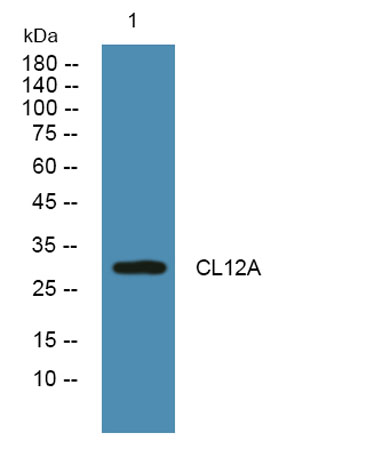
| Observed band (KD) | 29kD |
| Background | This gene encodes a member of the C-type lectin/C-type lectin-like domain (CTL/CTLD) superfamily. Members of this family share a common protein fold and have diverse functions, such as cell adhesion, cell-cell signaling, glycoprotein turnover, and roles in inflammation and immune response. The protein encoded by this gene is a negative regulator of granulocyte and monocyte function. Several alternatively spliced transcript variants of this gene have been described, but the full-length nature of some of these variants has not been determined. This gene is closely linked to other CTL/CTLD superfamily members in the natural killer gene complex region on chromosome 12p13. [provided by RefSeq, May 2011], |
| Function | domain:Contains 1 copy of a cytoplasmic motif that is referred to as the immunoreceptor tyrosine-based inhibitor motif (ITIM). This motif is involved in modulation of cellular responses. The phosphorylated ITIM motif can bind the SH2 domain of several SH2-containing phosphatases.,function:Cell surface receptor that modulates signaling cascades and mediates tyrosine phosphorylation of target MAP kinases.,function:Cell surface receptor that protects target cells against natural killer cell-mediated lysis. Modulates signaling cascades and mediates tyrosine phosphorylation of target MAP kinases.,induction:Down-regulated in activated leukocytes recruited to a site of inflammation.,PTM:Highly N-glycosylated. Glycosylation varies between cell types.,similarity:Contains 1 C-type lectin domain.,subcellular location:Ligand binding leads to internalization.,subunit:Homodimer. Interacts with PTPN6 a |
| Subcellular location | Cell membrane ; Single-pass type II membrane protein . Ligand binding leads to internalization. |
| Expression | Detected in normal myeloid cells and in acute myeloid leukemia cells. Detected in neutrophils, eosinophils, monocytes and dendritic cells. Detected in spleen macrophage-rich red pulp and in lymph node (at protein level). Detected in peripheral blood leukocytes, dendritic cells, bone marrow, monocytes, mononuclear leukocytes and macrophages. |

Use collapsible tabs for more detailed information that will help customers make a purchasing decision.
Ex: Shipping and return policies, size guides, and other common questions.