 Français
 English

| ELK.No | ES10999 |
| Product name | CFC1B rabbit pAb |
| Reactivity | Human;Rat;Mouse; |
| Applications | WB;ELISA |
| Other name | |
| Size | 50μL |
| Unit price ($) | 148 |
| Human gene ID | 653275 |
| Human Swiss-Prot | P0CG36 |
| Source | Rabbit |
| Isotype | IgG |
| Target | CFC1B |
| Fields | |
| Gene name | CFC1B |
| Protein name | Cryptic family protein 1B |
| Human gene link | |
| Human Swiss link | View Human Swiss-Prot |
| Mouse gene ID | |
| Mouse gene link | |
| Mouse Swiss-Prot | |
| Mouse Swiss link | |
| Rat gene ID | |
| Rat gene link | |
| Rat Swiss-Prot | |
| Rat Swiss link | |
| Immunogen | Synthesized peptide derived from part region of human protein |
| Specificity | CFC1B Polyclonal Antibody detects endogenous levels of protein. |
| Formulation | Liquid in PBS containing 50% glycerol, and 0.02% sodium azide. |
| Clonality | Polyclonal |
| Dilution | WB 1:500-2000 ELISA 1:5000-20000 |
| Purification | The antibody was affinity-purified from rabbit antiserum by affinity-chromatography using epitope-specific immunogen. |
| Concentration | 1 mg/ml |
| Storage stability | -20°C/1 year |
| Molecular Weight (Da) | |
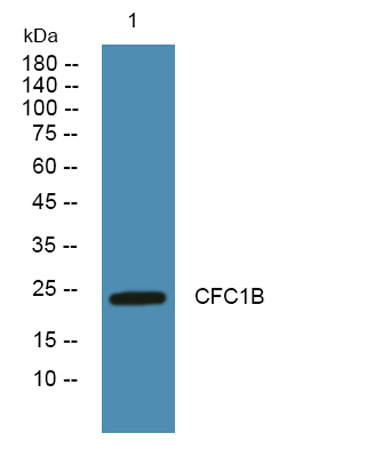
| Observed band (KD) | 24kD |
| Background | disease:Defects in CFC1 are a cause of conotruncal heart malformations (CTHM) [MIM:217095]. CTHM consist of cardiac outflow tract defects, such as tetralogy of Fallot, pulmonary atresia, double-outlet right ventricle, truncus arteriosus communis, and aortic arch anomalies.,disease:Defects in CFC1 are a cause of transposition of the great arteries, dextro-looped (DTGA) [MIM:608808]. The more common form of DTGA, consists of complete inversion of the great vessels, so that the aorta incorrectly arises from the right ventricle and the pulmonary artery incorrectly arises from the left ventricle. This creates completely separate pulmonary and systemic circulatory systems, an arrangement that is incompatible with life. Patients often have atrial and/or ventricular septal defects or other types of shunting that allow some mixing between the circulations in order to support life minimally, but surgical intervention is always required.,disease:Defects in CFC1 are a cause of visceral heterotaxy (HTX2) [MIM:605376]. HTX2 is an autosomal form of visceral heterotaxy (HTX). HTX is characterized by a variable group of congenital anomalies that include complex cardiac malformations and situs inversus or situs ambiguus.,function:Involved in the correct establishment of the left-right axis. May play a role in mesoderm and/or neural patterning during gastrulation.,PTM:N-glycosylated.,similarity:Contains 1 EGF-like domain., |
| Function | disease:Defects in CFC1 are a cause of conotruncal heart malformations (CTHM) [MIM:217095]. CTHM consist of cardiac outflow tract defects, such as tetralogy of Fallot, pulmonary atresia, double-outlet right ventricle, truncus arteriosus communis, and aortic arch anomalies.,disease:Defects in CFC1 are a cause of transposition of the great arteries, dextro-looped (DTGA) [MIM:608808]. The more common form of DTGA, consists of complete inversion of the great vessels, so that the aorta incorrectly arises from the right ventricle and the pulmonary artery incorrectly arises from the left ventricle. This creates completely separate pulmonary and systemic circulatory systems, an arrangement that is incompatible with life. Patients often have atrial and/or ventricular septal defects or other types of shunting that allow some mixing between the circulations in order to support life minimally, but s |
| Subcellular location | Secreted . |
| Expression | Lung,Subthalamic nucleus, |

Use collapsible tabs for more detailed information that will help customers make a purchasing decision.
Ex: Shipping and return policies, size guides, and other common questions.