 Français
 English

| ELK.No | ES11031 |
| Product name | CXL14 rabbit pAb |
| Reactivity | Human;Mouse |
| Applications | WB;ELISA |
| Other name | |
| Size | 100μL |
| Unit price ($) | 248 |
| Human gene ID | 9547 |
| Human Swiss-Prot | O95715 |
| Source | Rabbit |
| Isotype | IgG |
| Target | CXL14 |
| Fields | >>Cytokine-cytokine receptor interaction;>>Viral protein interaction with cytokine and cytokine receptor;>>Chemokine signaling pathway |
| Gene name | CXCL14 MIP2G NJAC SCYB14 PSEC0212 UNQ240/PRO273 |
| Protein name | C-X-C motif chemokine 14 (Chemokine BRAK) (MIP-2G) (Small-inducible cytokine B14) |
| Human gene link | |
| Human Swiss link | View Human Swiss-Prot |
| Mouse gene ID | |
| Mouse gene link | |
| Mouse Swiss-Prot | Q9WUQ5 |
| Mouse Swiss link | View Mouse Swiss-Prot |
| Rat gene ID | |
| Rat gene link | |
| Rat Swiss-Prot | |
| Rat Swiss link | |
| Immunogen | Synthesized peptide derived from part region of human protein AA range: 1-50 |
| Specificity | CXL14 Polyclonal Antibody detects endogenous levels of protein. |
| Formulation | Liquid in PBS containing 50% glycerol, and 0.02% sodium azide. |
| Clonality | Polyclonal |
| Dilution | WB 1:500-2000 ELISA 1:5000-20000 |
| Purification | The antibody was affinity-purified from rabbit antiserum by affinity-chromatography using epitope-specific immunogen. |
| Concentration | 1 mg/ml |
| Storage stability | -20°C/1 year |
| Molecular Weight (Da) | |
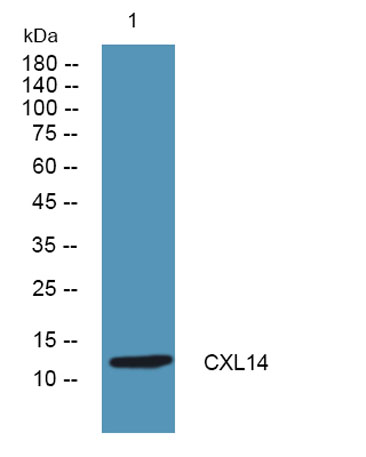
| Observed band (KD) | 12kD |
| Background | C-X-C motif chemokine ligand 14(CXCL14) Homo sapiens This antimicrobial gene belongs to the cytokine gene family which encode secreted proteins involved in immunoregulatory and inflammatory processes. The protein encoded by this gene is structurally related to the CXC (Cys-X-Cys) subfamily of cytokines. Members of this subfamily are characterized by two cysteines separated by a single amino acid. This cytokine displays chemotactic activity for monocytes but not for lymphocytes, dendritic cells, neutrophils or macrophages. It has been implicated that this cytokine is involved in the homeostasis of monocyte-derived macrophages rather than in inflammation. [provided by RefSeq, Sep 2014], |
| Function | function:Not chemotactive for T-cells, B-cells, monocytes, natural killer cells or ghranulocytes. Does not inhibit proliferation of myeloid progenitors in colony formation assays.,online information:CXCL14 entry,similarity:Belongs to the intercrine alpha (chemokine CxC) family.,tissue specificity:Expressed in heart, brain, placenta, lung, liver, skeletal muscle, kidney and pancreas. Highly expressed in normal tissue without inflammatory stimuli and infrequently expressed in cancer cell lines., |
| Subcellular location | Secreted. |
| Expression | Expressed in heart, brain, placenta, lung, liver, skeletal muscle, kidney and pancreas. Highly expressed in normal tissue without inflammatory stimuli and infrequently expressed in cancer cell lines. Weakly expressed in monocyte-derived dendritic cells. Not detected in lung or unstimulated peripheral blood lymphocytes. |

Use collapsible tabs for more detailed information that will help customers make a purchasing decision.
Ex: Shipping and return policies, size guides, and other common questions.