 Français
 English

| ELK.No | ES11070 |
| Product name | TREM2 rabbit pAb |
| Reactivity | Human;Mouse |
| Applications | WB;ELISA |
| Other name | |
| Size | 50μL |
| Unit price ($) | 148 |
| Human gene ID | 54209 |
| Human Swiss-Prot | Q9NZC2 |
| Source | Rabbit |
| Isotype | IgG |
| Target | TREM2 |
| Fields | >>Osteoclast differentiation |
| Gene name | TREM2 |
| Protein name | Triggering receptor expressed on myeloid cells 2 (TREM-2) (Triggering receptor expressed on monocytes 2) |
| Human gene link | |
| Human Swiss link | View Human Swiss-Prot |
| Mouse gene ID | |
| Mouse gene link | |
| Mouse Swiss-Prot | Q99NH8 |
| Mouse Swiss link | View Mouse Swiss-Prot |
| Rat gene ID | |
| Rat gene link | |
| Rat Swiss-Prot | |
| Rat Swiss link | |
| Immunogen | Synthesized peptide derived from part region of human protein |
| Specificity | TREM2 Polyclonal Antibody detects endogenous levels of protein. |
| Formulation | Liquid in PBS containing 50% glycerol, and 0.02% sodium azide. |
| Clonality | Polyclonal |
| Dilution | WB 1:500-2000 ELISA 1:5000-20000 |
| Purification | The antibody was affinity-purified from rabbit antiserum by affinity-chromatography using epitope-specific immunogen. |
| Concentration | 1 mg/ml |
| Storage stability | -20°C/1 year |
| Molecular Weight (Da) | |
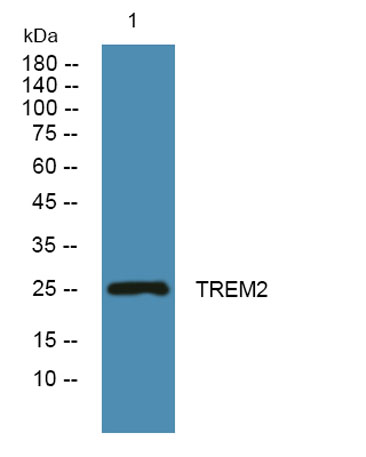
| Observed band (KD) | 25kD |
| Background | triggering receptor expressed on myeloid cells 2(TREM2) Homo sapiens This gene encodes a membrane protein that forms a receptor signaling complex with the TYRO protein tyrosine kinase binding protein. The encoded protein functions in immune response and may be involved in chronic inflammation by triggering the production of constitutive inflammatory cytokines. Defects in this gene are a cause of polycystic lipomembranous osteodysplasia with sclerosing leukoencephalopathy (PLOSL). Alternative splicing results in multiple transcript variants encoding different isoforms. [provided by RefSeq, Nov 2012], |
| Function | disease:Defects in TREM2 are a cause of polycystic lipomembranous osteodysplasia with sclerosing leukoencephalopathy (PLOSL) [MIM:221770]; also called presenile dementia with bone cysts or Nasu-Hakola disease (NHD). PLOSL is a recessively inherited disease characterized by a combination of psychotic symptoms rapidly progressing to presenile dementia and bone cysts restricted to wrists and ankles. PLOSL has a global distribution, although most of the patients have been diagnosed in Finland and Japan, with an estimated population prevalence of 2x10(-6) in the Finns.,function:May have a role in chronic inflammations and may stimulate production of constitutive rather than inflammatory chemokines and cytokines. Forms a receptor signaling complex with TYROBP and triggers activation of the immune responses in macrophages and dendritic cells.,similarity:Contains 1 Ig-like V-type (immunoglobulin |
| Subcellular location | [Isoform 1]: Cell membrane ; Single-pass type I membrane protein .; [Isoform 2]: Secreted .; [Isoform 3]: Secreted . |
| Expression | Expressed in the brain, specifically in microglia and in the fusiform gyrus (at protein level) (PubMed:28802038, PubMed:28855300, PubMed:27477018, PubMed:29752066). Expressed on macrophages and dendritic cells but not on granulocytes or monocytes (PubMed:10799849, PubMed:28855301). In the CNS strongest expression seen in the basal ganglia, corpus callosum, medulla oblongata and spinal cord (PubMed:12080485). |

Use collapsible tabs for more detailed information that will help customers make a purchasing decision.
Ex: Shipping and return policies, size guides, and other common questions.