 Français
 English

| ELK.No | ES11078 |
| Product name | SLPI rabbit pAb |
| Reactivity | Human;Mouse |
| Applications | WB;ELISA |
| Other name | |
| Size | 50μL |
| Unit price ($) | 148 |
| Human gene ID | 6590 |
| Human Swiss-Prot | P03973 |
| Source | Rabbit |
| Isotype | IgG |
| Target | SLPI |
| Fields | |
| Gene name | SLPI WAP4 WFDC4 |
| Protein name | Antileukoproteinase (ALP) (BLPI) (HUSI-1) (Mucus proteinase inhibitor) (MPI) (Protease inhibitor WAP4) (Secretory leukocyte protease inhibitor) (Seminal proteinase inhibitor) (WAP four-disulfide core |
| Human gene link | |
| Human Swiss link | View Human Swiss-Prot |
| Mouse gene ID | |
| Mouse gene link | |
| Mouse Swiss-Prot | P97430 |
| Mouse Swiss link | View Mouse Swiss-Prot |
| Rat gene ID | |
| Rat gene link | |
| Rat Swiss-Prot | |
| Rat Swiss link | |
| Immunogen | Synthesized peptide derived from part region of human protein |
| Specificity | SLPI Polyclonal Antibody detects endogenous levels of protein. |
| Formulation | Liquid in PBS containing 50% glycerol, and 0.02% sodium azide. |
| Clonality | Polyclonal |
| Dilution | WB 1:500-2000 ELISA 1:5000-20000 |
| Purification | The antibody was affinity-purified from rabbit antiserum by affinity-chromatography using epitope-specific immunogen. |
| Concentration | 1 mg/ml |
| Storage stability | -20°C/1 year |
| Molecular Weight (Da) | |
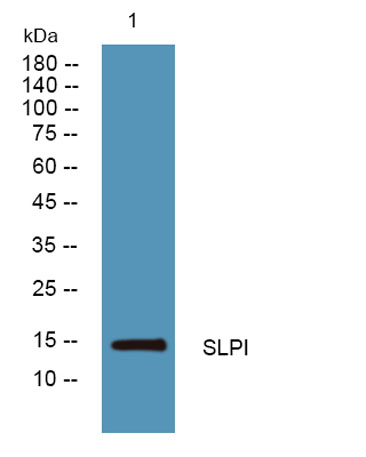
| Observed band (KD) | 14kD |
| Background | This gene encodes a secreted inhibitor which protects epithelial tissues from serine proteases. It is found in various secretions including seminal plasma, cervical mucus, and bronchial secretions, and has affinity for trypsin, leukocyte elastase, and cathepsin G. Its inhibitory effect contributes to the immune response by protecting epithelial surfaces from attack by endogenous proteolytic enzymes. This antimicrobial protein has antibacterial, antifungal and antiviral activity. [provided by RefSeq, Nov 2014], |
| Function | disease:The pathologies of several chronic and acute diseases of the respiratory tract involve an imbalance between the proteases of cells involved in inflammatary responses and the inhibitors of these proteases. The inflammation-mediated release of neutrophil elastase in the lungs of patients whose levels of active alpha-1-antiprotease are compromised by genetic background, cigarette smoking, air pollutants, or a combination of all three can result in severe lung damage and a decreased lifespan. The relatively small size of this protein, its lack of glycosylation and its stability make this protein a candidate for use as a therapeutic agent in diseases mediated by leukocyte elastase-antielastase imbalances.,function:Acid-stable proteinase inhibitor with strong affinities for trypsin, chymotrypsin, elastase, and cathepsin G. May prevent elastase-mediated damage to oral and possibly other |
| Subcellular location | Secreted . |
| Expression | Detected in blood plasma (PubMed:24352879). Detected in bone marrow myeloid cells (PubMed:24352879). Detected in airway sputum (PubMed:2039600). Detected in parotid gland secretions (PubMed:3462719). Detected in seminal plasma (at protein level) (PubMed:3485543). Detected in uterus cervix (PubMed:3533531). |

Use collapsible tabs for more detailed information that will help customers make a purchasing decision.
Ex: Shipping and return policies, size guides, and other common questions.