 Français
 English

| ELK.No | ES11186 |
| Product name | HAVR2 rabbit pAb |
| Reactivity | Human;Mouse |
| Applications | WB;ELISA |
| Other name | |
| Size | 50μL |
| Unit price ($) | 148 |
| Human gene ID | 84868 |
| Human Swiss-Prot | Q8TDQ0 |
| Source | Rabbit |
| Isotype | IgG |
| Target | HAVR2 |
| Fields | |
| Gene name | HAVCR2 TIM3 TIMD3 |
| Protein name | Hepatitis A virus cellular receptor 2 (HAVcr-2) (T-cell immunoglobulin and mucin domain-containing protein 3) (TIMD-3) (T-cell membrane protein 3) (TIM-3) |
| Human gene link | |
| Human Swiss link | View Human Swiss-Prot |
| Mouse gene ID | |
| Mouse gene link | |
| Mouse Swiss-Prot | Q8VIM0 |
| Mouse Swiss link | View Mouse Swiss-Prot |
| Rat gene ID | |
| Rat gene link | |
| Rat Swiss-Prot | |
| Rat Swiss link | |
| Immunogen | Synthesized peptide derived from human protein . at AA range: 10-90 |
| Specificity | HAVR2 Polyclonal Antibody detects endogenous levels of protein. |
| Formulation | Liquid in PBS containing 50% glycerol, and 0.02% sodium azide. |
| Clonality | Polyclonal |
| Dilution | WB 1:500-2000 ELISA 1:5000-20000 |
| Purification | The antibody was affinity-purified from rabbit antiserum by affinity-chromatography using epitope-specific immunogen. |
| Concentration | 1 mg/ml |
| Storage stability | -20°C/1 year |
| Molecular Weight (Da) | |
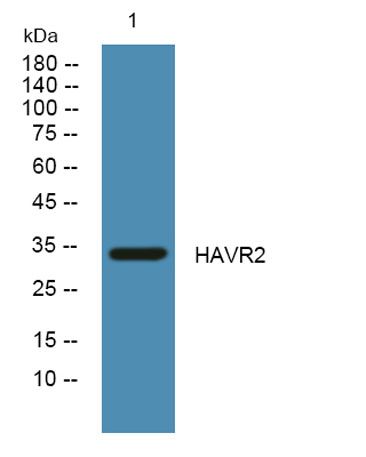
| Observed band (KD) | 33kD |
| Background | The protein encoded by this gene belongs to the immunoglobulin superfamily, and TIM family of proteins. CD4-positive T helper lymphocytes can be divided into types 1 (Th1) and 2 (Th2) on the basis of their cytokine secretion patterns. Th1 cells are involved in cell-mediated immunity to intracellular pathogens and delayed-type hypersensitivity reactions, whereas, Th2 cells are involved in the control of extracellular helminthic infections and the promotion of atopic and allergic diseases. This protein is a Th1-specific cell surface protein that regulates macrophage activation, and inhibits Th1-mediated auto- and alloimmune responses, and promotes immunological tolerance. [provided by RefSeq, Sep 2011], |
| Function | disease:Genetic variation in HAVCR2 may influence susceptibility to rheumatoid arthritis (RA) [MIM:180300]. RA is an inflammatory disease, primarily of the joints, with autoimmune features and a complex genetic component. It is characterized by inflammation of synovial tissues and the formation of rheumatoid pannus, which is capable of eroding adjacent cartilage and bone, causing subsequent joint destruction.,function:Regulates macrophage activation. Inhibits T-helper type 1 lymphocyte (Th1)-mediated auto- and alloimmune responses and promotes immunological tolerance. May be also involved in T-cell homing. Receptor for LGALS9.,similarity:Belongs to the immunoglobulin superfamily. TIM family.,similarity:Contains 1 Ig-like V-type (immunoglobulin-like) domain.,tissue specificity:T-helper type 1 lymphocyte (Th1)-specific., |
| Subcellular location | Membrane ; Single-pass type I membrane protein . Cell junction . Cell membrane . Localizes to the immunological synapse between CD8+ T-cells and target cells. . |
| Expression | Expressed in T-helper type 1 (Th1) lymphocytes. Expressed on regulatory T (Treg) cells after TCR stimulation. Expressed in dendritic cells and natural killer (NK) cells. Expressed in epithelial tissues. Expression is increased on CD4+ and CD8+ T-cells in chronic hepatitis C virus (HCV) infection. In progressive HIV-1 infection, expression is up-regulated on HIV-1-specific CD8 T-cells. |

Use collapsible tabs for more detailed information that will help customers make a purchasing decision.
Ex: Shipping and return policies, size guides, and other common questions.