 Français
 English

| ELK.No | ES11193 |
| Product name | DKKL1 rabbit pAb |
| Reactivity | Human;Mouse |
| Applications | WB;ELISA |
| Other name | |
| Size | 100μL |
| Unit price ($) | 248 |
| Human gene ID | 27120 |
| Human Swiss-Prot | Q9UK85 |
| Source | Rabbit |
| Isotype | IgG |
| Target | DKKL1 |
| Fields | |
| Gene name | DKKL1 SGY1 UNQ735/PRO1429 |
| Protein name | Dickkopf-like protein 1 (Cancer/testis antigen 34) (CT34) (Protein soggy-1) (SGY-1) |
| Human gene link | |
| Human Swiss link | View Human Swiss-Prot |
| Mouse gene ID | |
| Mouse gene link | |
| Mouse Swiss-Prot | Q9QZL9 |
| Mouse Swiss link | View Mouse Swiss-Prot |
| Rat gene ID | |
| Rat gene link | |
| Rat Swiss-Prot | |
| Rat Swiss link | |
| Immunogen | Synthesized peptide derived from human protein . at AA range: 50-130 |
| Specificity | DKKL1 Polyclonal Antibody detects endogenous levels of protein. |
| Formulation | Liquid in PBS containing 50% glycerol, and 0.02% sodium azide. |
| Clonality | Polyclonal |
| Dilution | WB 1:500-2000 ELISA 1:5000-20000 |
| Purification | The antibody was affinity-purified from rabbit antiserum by affinity-chromatography using epitope-specific immunogen. |
| Concentration | 1 mg/ml |
| Storage stability | -20°C/1 year |
| Molecular Weight (Da) | |
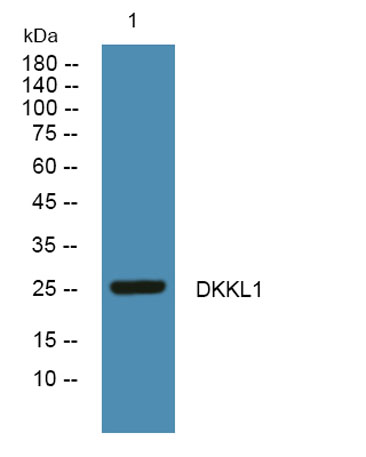
| Observed band (KD) | 26kD |
| Background | The dickkopf protein family interacts with the Wnt signaling pathway and its members are characterized by two conserved cysteine-rich domains. This gene encodes a secreted protein that has low sequence similarity to the dickkopf-3 protein. Multiple alternatively spliced transcript variants encoding distinct isoforms have been found for this gene. [provided by RefSeq, Oct 2010], |
| Function | PTM:N-glycosylated.,similarity:To the N-terminal section of DKK-3., |
| Subcellular location | Secreted . Cytoplasmic vesicle, secretory vesicle, acrosome . Localized specifically to the crescent shaped acrosome at the apex of the sperm head. . |
| Expression | More highly expressed in adult testis than in fetal testis. Exclusively expressed in the testis (at protein level). Intense expression in stages II, III and IV of spermatogenesis, whereas expression is lower in stage I. |

Use collapsible tabs for more detailed information that will help customers make a purchasing decision.
Ex: Shipping and return policies, size guides, and other common questions.