 Français
 English

| ELK.No | ES11230 |
| Product name | TNR19 rabbit pAb |
| Reactivity | Human;Mouse; |
| Applications | WB;ELISA |
| Other name | |
| Size | 50μL |
| Unit price ($) | 148 |
| Human gene ID | 55504 |
| Human Swiss-Prot | Q9NS68 |
| Source | Rabbit |
| Isotype | IgG |
| Target | TNR19 |
| Fields | >>Cytokine-cytokine receptor interaction |
| Gene name | TNFRSF19 TAJ TROY UNQ1888/PRO4333 |
| Protein name | Tumor necrosis factor receptor superfamily member 19 (TRADE) (Toxicity and JNK inducer) |
| Human gene link | |
| Human Swiss link | View Human Swiss-Prot |
| Mouse gene ID | |
| Mouse gene link | |
| Mouse Swiss-Prot | Q9JLL3 |
| Mouse Swiss link | View Mouse Swiss-Prot |
| Rat gene ID | |
| Rat gene link | |
| Rat Swiss-Prot | |
| Rat Swiss link | |
| Immunogen | Synthesized peptide derived from human protein . at AA range: 20-100 |
| Specificity | TNR19 Polyclonal Antibody detects endogenous levels of protein. |
| Formulation | Liquid in PBS containing 50% glycerol, and 0.02% sodium azide. |
| Clonality | Polyclonal |
| Dilution | WB 1:500-2000 ELISA 1:5000-20000 |
| Purification | The antibody was affinity-purified from rabbit antiserum by affinity-chromatography using epitope-specific immunogen. |
| Concentration | 1 mg/ml |
| Storage stability | -20°C/1 year |
| Molecular Weight (Da) | |
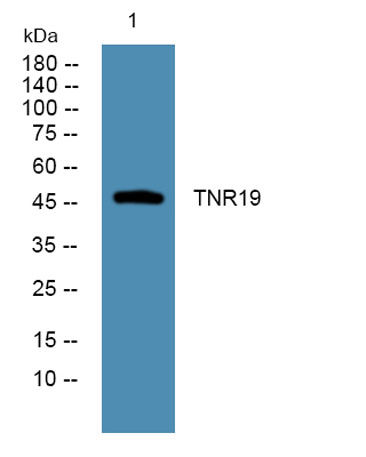
| Observed band (KD) | 46kD |
| Background | The protein encoded by this gene is a member of the TNF-receptor superfamily. This receptor is highly expressed during embryonic development. It has been shown to interact with TRAF family members, and to activate JNK signaling pathway when overexpressed in cells. This receptor is capable of inducing apoptosis by a caspase-independent mechanism, and it is thought to play an essential role in embryonic development. Alternatively spliced transcript variants encoding distinct isoforms have been described. [provided by RefSeq, Jul 2008], |
| Function | function:Can mediate activation of JNK and NF-kappa-B. May promote caspase-independent cell death.,similarity:Contains 3 TNFR-Cys repeats.,subunit:Associates with TRAF1, TRAF2, TRAF3 and TRAF5. Interacts with LINGO1.,tissue specificity:Highly expressed in prostate. Detected at lower levels in thymus, spleen, testis, uterus, small intestine, colon and peripheral blood leukocytes., |
| Subcellular location | Membrane ; Single-pass type I membrane protein . |
| Expression | Highly expressed in prostate. Detected at lower levels in thymus, spleen, testis, uterus, small intestine, colon and peripheral blood leukocytes. |

Use collapsible tabs for more detailed information that will help customers make a purchasing decision.
Ex: Shipping and return policies, size guides, and other common questions.