 Français
 English

| ELK.No | ES11243 |
| Product name | LN28B rabbit pAb |
| Reactivity | Human;Mouse |
| Applications | WB;ELISA |
| Other name | |
| Size | 50μL |
| Unit price ($) | 148 |
| Human gene ID | 389421 |
| Human Swiss-Prot | Q6ZN17 |
| Source | Rabbit |
| Isotype | IgG |
| Target | LN28B |
| Fields | |
| Gene name | LIN28B CSDD2 |
| Protein name | Protein lin-28 homolog B (Lin-28B) |
| Human gene link | |
| Human Swiss link | View Human Swiss-Prot |
| Mouse gene ID | |
| Mouse gene link | |
| Mouse Swiss-Prot | Q45KJ6 |
| Mouse Swiss link | View Mouse Swiss-Prot |
| Rat gene ID | |
| Rat gene link | |
| Rat Swiss-Prot | |
| Rat Swiss link | |
| Immunogen | Synthesized peptide derived from human protein . at AA range: 60-140 |
| Specificity | LN28B Polyclonal Antibody detects endogenous levels of protein. |
| Formulation | Liquid in PBS containing 50% glycerol, and 0.02% sodium azide. |
| Clonality | Polyclonal |
| Dilution | WB 1:500-2000 ELISA 1:5000-20000 |
| Purification | The antibody was affinity-purified from rabbit antiserum by affinity-chromatography using epitope-specific immunogen. |
| Concentration | 1 mg/ml |
| Storage stability | -20°C/1 year |
| Molecular Weight (Da) | |
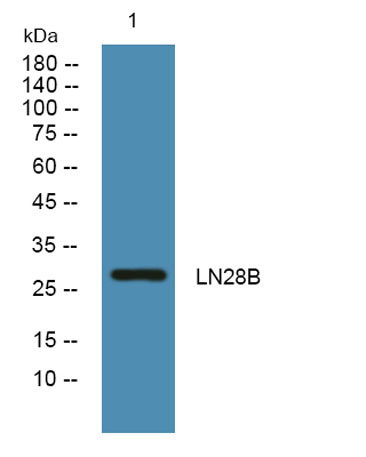
| Observed band (KD) | 27kD |
| Background | The protein encoded by this gene belongs to the lin-28 family, which is characterized by the presence of a cold-shock domain and a pair of CCHC zinc finger domains. This gene is highly expressed in testis, fetal liver, placenta, and in primary human tumors and cancer cell lines. It is negatively regulated by microRNAs that target sites in the 3' UTR, and overexpression of this gene in primary tumors is linked to the repression of let-7 family of microRNAs and derepression of let-7 targets, which facilitates cellular transformation. [provided by RefSeq, Jun 2012], |
| Function | function:When overexpressed, isoform 1 stimulates growth of the breast adenocarcinoma cell line MCF-7. Isoform 2 has no effect on cell growth.,induction:Might be negatively regulated by the microRNA let-7b.,similarity:Belongs to the lin-28 family.,similarity:Contains 1 CSD (cold-shock) domain.,similarity:Contains 2 CCHC-type zinc fingers.,subcellular location:Predominantly cytoplasmic at G1 phase, accumulates in the nucleus in S and G2 phases. The frequency of nuclear localization in S and in G2 phases is 60% and 30%, respectively.,tissue specificity:High expression in testis, fetal liver, placenta and in hepatocellular carcinoma (HCC). Isoform 1 is only detected in moderately and poorly differentiated HCC tissues and placenta (at protein level). Isoform 2 is detected in fetal liver, non-tumor liver tissues, as well as well-differentiated tumor tissues (at protein level)., |
| Subcellular location | Nucleus. Nucleus, nucleolus . Cytoplasm . Predominantly nucleolar (PubMed:22118463). In Huh7 cells, predominantly cytoplasmic, with only a subset of cells exhibiting strong nuclear staining; however, the specificity of the polyclonal antibody used in these experiments has not been not documented (PubMed:16971064). . |
| Expression | Expressed at high levels in the placenta and, at mucher lower, in testis and fetal liver (PubMed:16971064). Isoform 1 is only detected in placenta and in moderately and poorly differentiated hepatocellular carcinoma cells (at protein level). Isoform 2 is detected in fetal liver, non-tumor liver tissues, as well as well-differentiated tumor tissues (at protein level). Tends to be up-regulated in triple-negative (ER-,PR-,HER2-) breast tumors, as well as in liver, ovarian, and thyroid carcinomas (PubMed:22118463). |

Use collapsible tabs for more detailed information that will help customers make a purchasing decision.
Ex: Shipping and return policies, size guides, and other common questions.