 Français
 English

| ELK.No | ES11301 |
| Product name | CHIP rabbit pAb |
| Reactivity | Human;Mouse |
| Applications | WB;ELISA |
| Other name | |
| Size | 50μL |
| Unit price ($) | 148 |
| Human gene ID | 10273 |
| Human Swiss-Prot | Q9UNE7 |
| Source | Rabbit |
| Isotype | IgG |
| Target | CHIP |
| Fields | >>Ubiquitin mediated proteolysis;>>Protein processing in endoplasmic reticulum |
| Gene name | STUB1 CHIP PP1131 |
| Protein name | E3 ubiquitin-protein ligase CHIP (EC 6.3.2.-) (Antigen NY-CO-7) (CLL-associated antigen KW-8) (Carboxy terminus of Hsp70-interacting protein) (STIP1 homology and U box-containing protein 1) |
| Human gene link | |
| Human Swiss link | View Human Swiss-Prot |
| Mouse gene ID | |
| Mouse gene link | |
| Mouse Swiss-Prot | Q9WUD1 |
| Mouse Swiss link | View Mouse Swiss-Prot |
| Rat gene ID | |
| Rat gene link | |
| Rat Swiss-Prot | |
| Rat Swiss link | |
| Immunogen | Synthesized peptide derived from human protein . at AA range: 160-240 |
| Specificity | CHIP Polyclonal Antibody detects endogenous levels of protein. |
| Formulation | Liquid in PBS containing 50% glycerol, and 0.02% sodium azide. |
| Clonality | Polyclonal |
| Dilution | WB 1:500-2000 ELISA 1:5000-20000 |
| Purification | The antibody was affinity-purified from rabbit antiserum by affinity-chromatography using epitope-specific immunogen. |
| Concentration | 1 mg/ml |
| Storage stability | -20°C/1 year |
| Molecular Weight (Da) | |
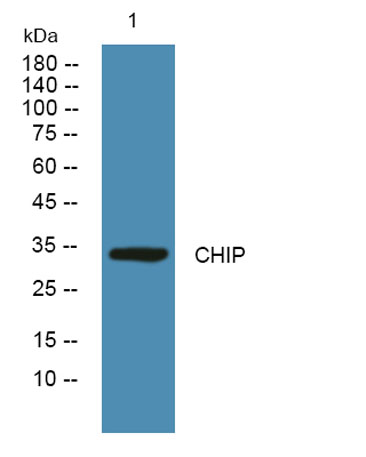
| Observed band (KD) | 33kD |
| Background | This gene encodes a protein containing tetratricopeptide repeat and a U-box that functions as a ubiquitin ligase/cochaperone. The encoded protein binds to and ubiquitinates shock cognate 71 kDa protein (Hspa8) and DNA polymerase beta (Polb), among other targets. Mutations in this gene cause spinocerebellar ataxia, autosomal recessive 16. Alternative splicing results in multiple transcript variants. There is a pseudogene for this gene on chromosome 2. [provided by RefSeq, Jun 2014], |
| Function | disease:Antibodies against STUB1 are found in patients with chronic lymphocytic leukemia (CLL) and in colorectal cancer patients.,function:Modulates the activity of several chaperone complexes, including Hsp70, Hsc70 and Hsp90. Has E3 ubiquitin-protein ligase activity and targets misfolded chaperone substrates towards proteasomal degradation. Mediates transfer of non-canonical short ubiquitin chains to HSPA8 that have no effect on HSPA8 degradation.,PTM:Auto-ubiquitinated (in vitro).,PTM:Phosphorylated upon DNA damage, probably by ATM or ATR.,similarity:Contains 1 U-box domain.,similarity:Contains 3 TPR repeats.,subunit:Interacts with BAG2, and with the E2 ubiquitin conjugating enzymes UBE2D1, UBE2D2 and UBE2D3. Interacts with the C-terminal domains of HSPA8 and HSPA1A. Detected in a ternary complex containing STUB1, HSPA1A and HSPBP1.,tissue specificity:Highly expressed in skeletal musc |
| Subcellular location | Cytoplasm . Nucleus . Translocates to the nucleus in response to inflammatory signals in regulatory T-cells (Treg). . |
| Expression | Expressed in differentiated myotubes (at protein level) (PubMed:17369820). Highly expressed in skeletal muscle, heart, pancreas, brain and placenta (PubMed:10330192, PubMed:11435423). Detected in kidney, liver and lung (PubMed:10330192, PubMed:11435423). |

Use collapsible tabs for more detailed information that will help customers make a purchasing decision.
Ex: Shipping and return policies, size guides, and other common questions.