 Français
 English
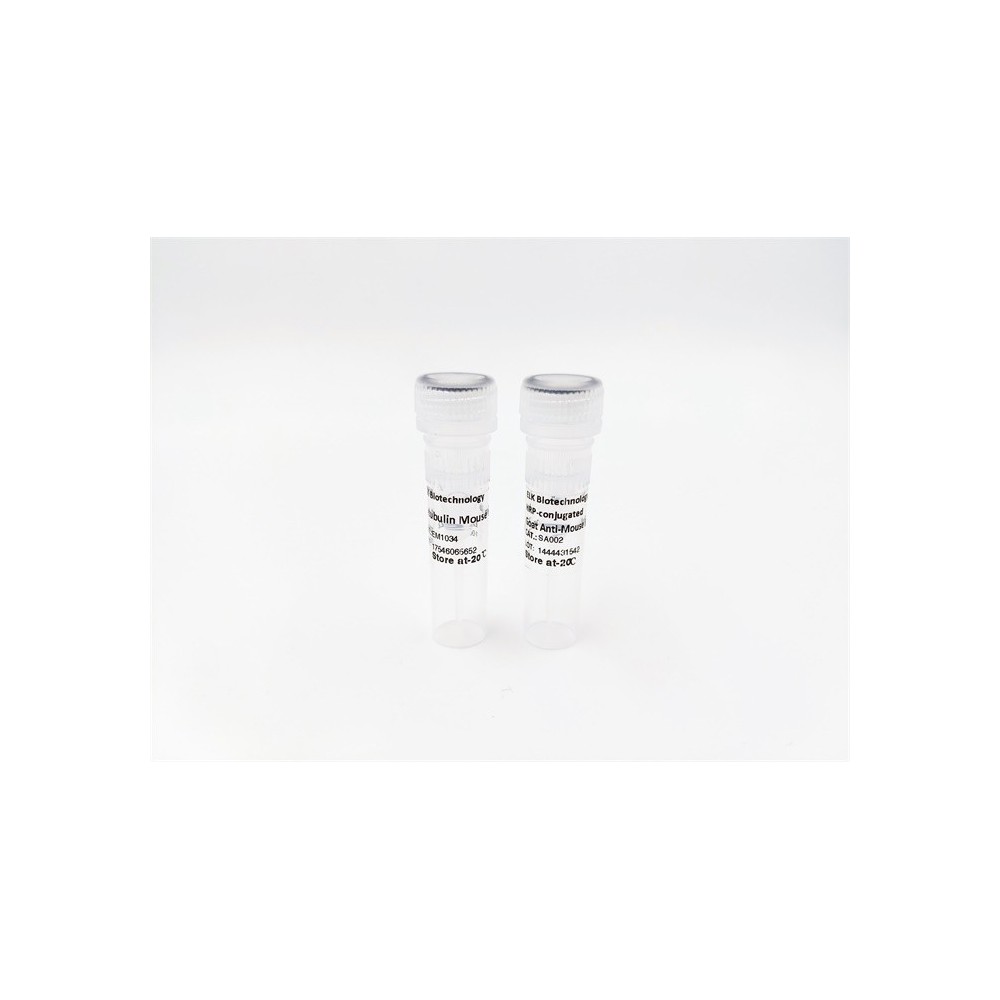
CRM1 (Acetyl Lys568) rabbit pAb
AO-06-ES1133-50

| ELK.No | ES1133 |
| Product name | CRM1 (Acetyl Lys568) rabbit pAb |
| Reactivity | Human;Mouse;Rat |
| Applications | WB;ELISA |
| Other name | XPO1; CRM1; Exportin-1; Exp1; Chromosome region maintenance 1 protein homolog |
| Size | 50μL |
| Unit price ($) | 148 |
| Human gene ID | 7514 |
| Human Swiss-Prot | O14980 |
| Source | Rabbit |
| Isotype | IgG |
| Target | CRM1 |
| Fields | >>Ribosome biogenesis in eukaryotes;>>Nucleocytoplasmic transport;>>Viral life cycle - HIV-1;>>Influenza A;>>Human T-cell leukemia virus 1 infection |
| Gene name | XPO1 |
| Protein name | Exportin-1 |
| Human gene link | View Human Gene |
| Human Swiss link | View Human Swiss-Prot |
| Mouse gene ID | 103573 |
| Mouse gene link | View Mouse Gene |
| Mouse Swiss-Prot | Q6P5F9 |
| Mouse Swiss link | View Mouse Swiss-Prot |
| Rat gene ID | 85252 |
| Rat gene link | View Rat Gene |
| Rat Swiss-Prot | Q80U96 |
| Rat Swiss link | View Rat Swiss-Prot |
| Immunogen | Synthesized acetyl-peptide derived from the Internal region of human CRM1 around the acetylation site of K568. |
| Specificity | Acetyl-CRM1 (K568) Polyclonal Antibody detects endogenous levels of CRM1 protein only when acetylation at K568. |
| Formulation | Liquid in PBS containing 50% glycerol, 0.5% BSA and 0.02% sodium azide. |
| Clonality | Polyclonal |
| Dilution | Western Blot: 1/500 - 1/2000. ELISA: 1/10000. Not yet tested in other applications. |
| Purification | The antibody was affinity-purified from rabbit antiserum by affinity-chromatography using epitope-specific immunogen. |
| Concentration | 1 mg/ml |
| Storage stability | -20°C/1 year |
| Molecular Weight (Da) | |
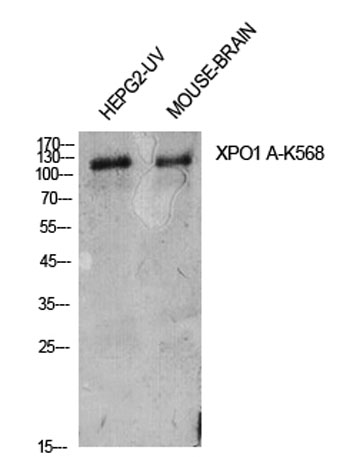
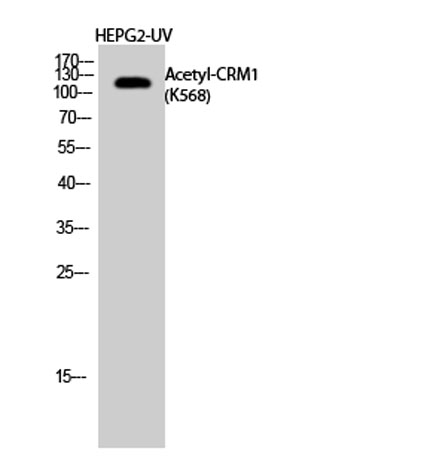
| Observed band (KD) | 125kD |
| Background | This cell-cycle-regulated gene encodes a protein that mediates leucine-rich nuclear export signal (NES)-dependent protein transport. The protein specifically inhibits the nuclear export of Rev and U snRNAs. It is involved in the control of several cellular processes by controlling the localization of cyclin B, MPAK, and MAPKAP kinase 2. This protein also regulates NFAT and AP-1. [provided by RefSeq, Jan 2015], |
| Function | function:Mediates the nuclear export of cellular proteins (cargos) bearing a leucine-rich nuclear export signal (NES) and of RNAs. In the nucleus, in association with RANBP3, binds cooperatively to the NES on its target protein and to the GTPase RAN in its active GTP-bound form (Ran-GTP). Docking of this complex to the nuclear pore complex (NPC) is mediated through binding to nucleoporins. Upon transit of an nuclear export complex into the cytoplasm, disassembling of the complex and hydrolysis of Ran-GTP to Ran-GDP (induced by RANBP1 and RANGAP1, respectively) cause release of the cargo from the export receptor. The directionality of nuclear export is thought to be conferred by an asymmetric distribution of the GTP- and GDP-bound forms of Ran between the cytoplasm and nucleus. Involved in U3 snoRNA transport from Cajal bodies to nucleoli. Binds to late precursor U3 snoRNA bearing a TMG c |
| Subcellular location | Cytoplasm. Nucleus, nucleoplasm. Nucleus, Cajal body. Nucleus, nucleolus. Located in the nucleoplasm, Cajal bodies and nucleoli. Shuttles between the nucleus/nucleolus and the cytoplasm. |
| Expression | Expressed in heart, brain, placenta, lung, liver, skeletal muscle, pancreas, spleen, thymus, prostate, testis, ovary, small intestine, colon and peripheral blood leukocytes. Not expressed in the kidney. |

Use collapsible tabs for more detailed information that will help customers make a purchasing decision.
Ex: Shipping and return policies, size guides, and other common questions.