 Français
 English

| ELK.No | ES11385 |
| Product name | SLUR1 rabbit pAb |
| Reactivity | Human;Rat;Mouse; |
| Applications | WB;ELISA |
| Other name | |
| Size | 100μL |
| Unit price ($) | 248 |
| Human gene ID | 57152 |
| Human Swiss-Prot | P55000 |
| Source | Rabbit |
| Isotype | IgG |
| Target | SLUR1 |
| Fields | >>Neuroactive ligand-receptor interaction |
| Gene name | SLURP1 ARS |
| Protein name | Secreted Ly-6/uPAR-related protein 1 (SLURP-1) (ARS component B) (ARS(component B)-81/S) (Anti-neoplastic urinary protein) (ANUP) |
| Human gene link | |
| Human Swiss link | View Human Swiss-Prot |
| Mouse gene ID | |
| Mouse gene link | |
| Mouse Swiss-Prot | Q9Z0K7 |
| Mouse Swiss link | View Mouse Swiss-Prot |
| Rat gene ID | |
| Rat gene link | |
| Rat Swiss-Prot | |
| Rat Swiss link | |
| Immunogen | Synthesized peptide derived from human protein . at AA range: 11-60 |
| Specificity | SLUR1 Polyclonal Antibody detects endogenous levels of protein. |
| Formulation | Liquid in PBS containing 50% glycerol, and 0.02% sodium azide. |
| Clonality | Polyclonal |
| Dilution | WB 1:500-2000 ELISA 1:5000-20000 |
| Purification | The antibody was affinity-purified from rabbit antiserum by affinity-chromatography using epitope-specific immunogen. |
| Concentration | 1 mg/ml |
| Storage stability | -20°C/1 year |
| Molecular Weight (Da) | |
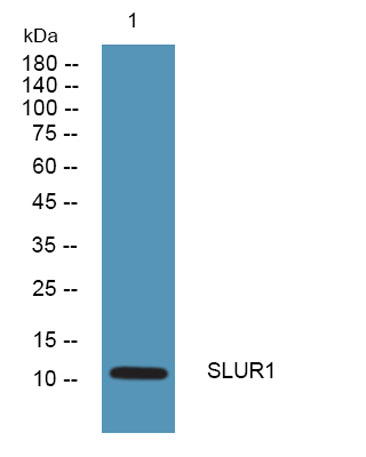
| Observed band (KD) | 11kD |
| Background | The protein encoded by this gene is a member of the Ly6/uPAR family but lacks a GPI-anchoring signal sequence. It is thought that this secreted protein contains antitumor activity. Mutations in this gene have been associated with Mal de Meleda, a rare autosomal recessive skin disorder. This gene maps to the same chromosomal region as several members of the Ly6/uPAR family of glycoprotein receptors. [provided by RefSeq, Jul 2008], |
| Function | caution:It is not certain that ARS and ANUP are identical proteins.,disease:Defects in SLURP1 are a cause of Mal de Meleda (MDM) [MIM:248300]; also known as keratosis palmoplantaris transgradiens of Siemens. MDM is a rare autosomal recessive skin disorder, characterized by diffuse transgressive palmoplantar keratoderma with keratotic lesions extending onto the dorsa of the hands and the feet (transgrediens). Patients may have hyperhidrosis. Other features include perioral erythema, lichenoid plaques on the knees and the elbows, and nail abnormalities.,function:Has an antitumor activity. Was found to be a marker of late differentiation of the skin. Implicated in maintaining the physiological and structural integrity of the keratinocyte layers of the skin.,induction:Regulated by retinoic acid, epidermal growth factor and interferon-gamma.,similarity:Contains 1 UPAR/Ly6 domain.,subunit:Homo |
| Subcellular location | Secreted . |
| Expression | Granulocytes. Expressed in skin. Predominantly expressed in the granular layer of skin, notably the acrosyringium. Identified in several biological fluids such as sweat, saliva, tears, plasma and urine. |

Use collapsible tabs for more detailed information that will help customers make a purchasing decision.
Ex: Shipping and return policies, size guides, and other common questions.