 Français
 English

| ELK.No | ES11395 |
| Product name | TADBP rabbit pAb |
| Reactivity | Human;Mouse |
| Applications | WB;ELISA |
| Other name | |
| Size | 50μL |
| Unit price ($) | 148 |
| Human gene ID | 23435 |
| Human Swiss-Prot | Q13148 |
| Source | Rabbit |
| Isotype | IgG |
| Target | TADBP |
| Fields | >>mRNA surveillance pathway;>>Amyotrophic lateral sclerosis;>>Pathways of neurodegeneration - multiple diseases |
| Gene name | TARDBP TDP43 |
| Protein name | TAR DNA-binding protein 43 (TDP-43) |
| Human gene link | |
| Human Swiss link | View Human Swiss-Prot |
| Mouse gene ID | |
| Mouse gene link | |
| Mouse Swiss-Prot | Q921F2 |
| Mouse Swiss link | View Mouse Swiss-Prot |
| Rat gene ID | |
| Rat gene link | |
| Rat Swiss-Prot | |
| Rat Swiss link | |
| Immunogen | Synthesized peptide derived from human protein . at AA range: 41-90 |
| Specificity | TADBP Polyclonal Antibody detects endogenous levels of protein. |
| Formulation | Liquid in PBS containing 50% glycerol, and 0.02% sodium azide. |
| Clonality | Polyclonal |
| Dilution | WB 1:500-2000 ELISA 1:5000-20000 |
| Purification | The antibody was affinity-purified from rabbit antiserum by affinity-chromatography using epitope-specific immunogen. |
| Concentration | 1 mg/ml |
| Storage stability | -20°C/1 year |
| Molecular Weight (Da) | |
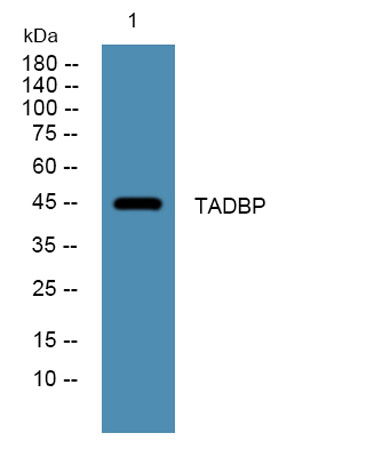
| Observed band (KD) | 45kD |
| Background | TAR DNA binding protein(TARDBP) Homo sapiens HIV-1, the causative agent of acquired immunodeficiency syndrome (AIDS), contains an RNA genome that produces a chromosomally integrated DNA during the replicative cycle. Activation of HIV-1 gene expression by the transactivator Tat is dependent on an RNA regulatory element (TAR) located downstream of the transcription initiation site. The protein encoded by this gene is a transcriptional repressor that binds to chromosomally integrated TAR DNA and represses HIV-1 transcription. In addition, this protein regulates alternate splicing of the CFTR gene. A similar pseudogene is present on chromosome 20. [provided by RefSeq, Jul 2008], |
| Function | disease:Defects in TARDBP are a cause of amyotrophic lateral sclerosis type 10 (ALS10) [MIM:612069]. ALS is a neurodegenerative disorder affecting upper and lower motor neurons and resulting in fatal paralysis. Sensory abnormalities are absent. Death usually occurs within 2 to 5 years. The etiology of ALS is likely to be multifactorial, involving both genetic and environmental factors. TARDBP is the primary component of ubiquitin-positive inclusion bodies found in ALS and in frontotemporal lobar degeneration with ubiquitin-positive inclusions (FTLDU).,function:DNA and RNA-binding protein which regulates transcription and splicing. Involved in the regulation of CFTR splicing. It promotes CFTR exon 9 skipping by binding to the UG repeated motifs in the polymorphic region near the 3'-splice site of this exon. The resulting aberrant splicing is associated with pathological features typical o |
| Subcellular location | Nucleus . Cytoplasm . Cytoplasm, Stress granule . Mitochondrion . Continuously travels in and out of the nucleus (PubMed:18957508). Localizes to stress granules in response to oxidative stress (PubMed:19765185). A small subset localizes in mitochondria (PubMed:28794432). . |
| Expression | Ubiquitously expressed. In particular, expression is high in pancreas, placenta, lung, genital tract and spleen. |

Use collapsible tabs for more detailed information that will help customers make a purchasing decision.
Ex: Shipping and return policies, size guides, and other common questions.