 Français
 English

| ELK.No | ES11464 |
| Product name | FPR2 rabbit pAb |
| Reactivity | Human;Rat;Mouse;;Swine |
| Applications | WB;ELISA |
| Other name | |
| Size | 100μL |
| Unit price ($) | 248 |
| Human gene ID | 2358 |
| Human Swiss-Prot | P25090 |
| Source | Rabbit |
| Isotype | IgG |
| Target | FPR2 |
| Fields | >>Neuroactive ligand-receptor interaction;>>Neutrophil extracellular trap formation;>>Staphylococcus aureus infection |
| Gene name | FPR2 FPRH1 FPRL1 LXA4R |
| Protein name | N-formyl peptide receptor 2 (FMLP-related receptor I) (FMLP-R-I) (Formyl peptide receptor-like 1) (HM63) (Lipoxin A4 receptor) (LXA4 receptor) (RFP) |
| Human gene link | |
| Human Swiss link | View Human Swiss-Prot |
| Mouse gene ID | |
| Mouse gene link | |
| Mouse Swiss-Prot | O88536 |
| Mouse Swiss link | View Mouse Swiss-Prot |
| Rat gene ID | |
| Rat gene link | |
| Rat Swiss-Prot | |
| Rat Swiss link | |
| Immunogen | Synthesized peptide derived from human protein . at AA range: 130-210 |
| Specificity | FPR2 Polyclonal Antibody detects endogenous levels of protein. |
| Formulation | Liquid in PBS containing 50% glycerol, and 0.02% sodium azide. |
| Clonality | Polyclonal |
| Dilution | WB 1:500-2000 ELISA 1:5000-20000 |
| Purification | The antibody was affinity-purified from rabbit antiserum by affinity-chromatography using epitope-specific immunogen. |
| Concentration | 1 mg/ml |
| Storage stability | -20°C/1 year |
| Molecular Weight (Da) | |
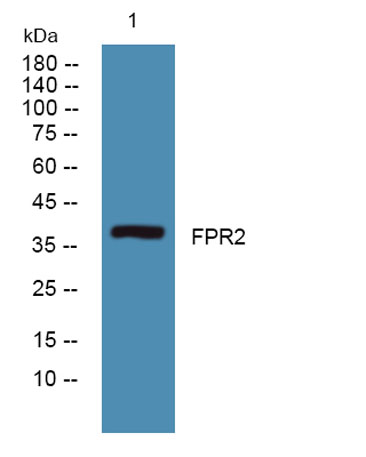
| Observed band (KD) | 38kD |
| Background | function:Low affinity receptor for N-formyl-methionyl peptides, which are powerful neutrophils chemotactic factors. Binding of FMLP to the receptor causes activation of neutrophils. This response is mediated via a G-protein that activates a phosphatidylinositol-calcium second messenger system. The activation of LXA4R could result in an anti-inflammatory outcome counteracting the actions of proinflammatory signals such as LTB4 (leukotriene B4).,similarity:Belongs to the G-protein coupled receptor 1 family.,tissue specificity:Expressed abundantly in the lung and neutrophils. Also found in the spleen and testis., |
| Function | function:Low affinity receptor for N-formyl-methionyl peptides, which are powerful neutrophils chemotactic factors. Binding of FMLP to the receptor causes activation of neutrophils. This response is mediated via a G-protein that activates a phosphatidylinositol-calcium second messenger system. The activation of LXA4R could result in an anti-inflammatory outcome counteracting the actions of proinflammatory signals such as LTB4 (leukotriene B4).,similarity:Belongs to the G-protein coupled receptor 1 family.,tissue specificity:Expressed abundantly in the lung and neutrophils. Also found in the spleen and testis., |
| Subcellular location | Cell membrane ; Multi-pass membrane protein. Associates with Amyloid-beta protein 42, product of APP, at the cell surface and the complex is then rapidly internalized (PubMed:11689470). Also internalized in the presence of humanin (PubMed:15465011). . |
| Expression | Detected in lung, bone marrow, neutrophils, spleen and testis. |

Use collapsible tabs for more detailed information that will help customers make a purchasing decision.
Ex: Shipping and return policies, size guides, and other common questions.