 Français
 English

| ELK.No | ES11634 |
| Product name | T2R38 rabbit pAb |
| Reactivity | Human;Rat;Mouse |
| Applications | WB;ELISA |
| Other name | |
| Size | 100μL |
| Unit price ($) | 248 |
| Human gene ID | 5726 |
| Human Swiss-Prot | P59533 |
| Source | Rabbit |
| Isotype | IgG |
| Target | T2R38 |
| Fields | >>Taste transduction |
| Gene name | TAS2R38 PTC |
| Protein name | Taste receptor type 2 member 38 (T2R38) (PTC bitter taste receptor) (Taste receptor type 2 member 61) (T2R61) |
| Human gene link | |
| Human Swiss link | View Human Swiss-Prot |
| Mouse gene ID | |
| Mouse gene link | |
| Mouse Swiss-Prot | Q7TQA6 |
| Mouse Swiss link | View Mouse Swiss-Prot |
| Rat gene ID | |
| Rat gene link | |
| Rat Swiss-Prot | Q4VHE7 |
| Rat Swiss link | View Rat Swiss-Prot |
| Immunogen | Synthesized peptide derived from human protein . at AA range: 180-260 |
| Specificity | T2R38 Polyclonal Antibody detects endogenous levels of protein. |
| Formulation | Liquid in PBS containing 50% glycerol, and 0.02% sodium azide. |
| Clonality | Polyclonal |
| Dilution | WB 1:500-2000 ELISA 1:5000-20000 |
| Purification | The antibody was affinity-purified from rabbit antiserum by affinity-chromatography using epitope-specific immunogen. |
| Concentration | 1 mg/ml |
| Storage stability | -20°C/1 year |
| Molecular Weight (Da) | |
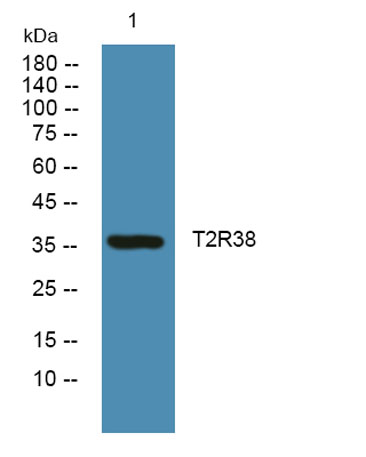
| Observed band (KD) | 36kD |
| Background | This gene encodes a seven-transmembrane G protein-coupled receptor that controls the ability to taste glucosinolates, a family of bitter-tasting compounds found in plants of the Brassica sp. Synthetic compounds phenylthiocarbamide (PTC) and 6-n-propylthiouracil (PROP) have been identified as ligands for this receptor and have been used to test the genetic diversity of this gene. Although several allelic forms of this gene have been identified worldwide, there are two predominant common forms (taster and non-taster) found outside of Africa. These alleles differ at three nucleotide positions resulting in amino acid changes in the protein (A49P, A262V, and V296I) with the amino acid combination PAV identifying the taster variant (and AVI identifying the non-taster variant). [provided by RefSeq, Oct 2009], |
| Function | function:Receptor that may play a role in the perception of bitterness and is gustducin-linked. May play a role in sensing the chemical composition of the gastrointestinal content. The activity of this receptor may stimulate alpha gustducin, mediate PLC-beta-2 activation and lead to the gating of TRPM5.,miscellaneous:Most taste cells may be activated by a limited number of bitter compounds; individual taste cells can discriminate among bitter stimuli.,polymorphism:Variations in TAS2R38 are associated with the ability to taste phenylthiocarbamide (PTC tasting) [MIM:171200]; also called thiourea tasting. The ability to taste the substance PTC and a number of related substances is genetically controlled. Genetic studies have demonstrated complex inheritance for this trait. For some people (and some chimpanzees also), the chemical PTC tastes very bitter. For others, it is tasteless. Actually |
| Subcellular location | Membrane; Multi-pass membrane protein. |
| Expression | Expressed in subsets of taste receptor cells of the tongue and exclusively in gustducin-positive cells. Expressed in testis (PubMed:16720576). |

Use collapsible tabs for more detailed information that will help customers make a purchasing decision.
Ex: Shipping and return policies, size guides, and other common questions.