 Français
 English

| ELK.No | ES11641 |
| Product name | TAAR1 rabbit pAb |
| Reactivity | Human;Mouse;Rat |
| Applications | WB;ELISA |
| Other name | |
| Size | 50μL |
| Unit price ($) | 148 |
| Human gene ID | 134864 |
| Human Swiss-Prot | Q96RJ0 |
| Source | Rabbit |
| Isotype | IgG |
| Target | TAAR1 |
| Fields | >>Neuroactive ligand-receptor interaction |
| Gene name | TAAR1 TA1 TAR1 TRAR1 |
| Protein name | Trace amine-associated receptor 1 (TaR-1) (Trace amine receptor 1) |
| Human gene link | |
| Human Swiss link | View Human Swiss-Prot |
| Mouse gene ID | |
| Mouse gene link | |
| Mouse Swiss-Prot | Q923Y8 |
| Mouse Swiss link | View Mouse Swiss-Prot |
| Rat gene ID | |
| Rat gene link | |
| Rat Swiss-Prot | Q923Y9 |
| Rat Swiss link | View Rat Swiss-Prot |
| Immunogen | Synthesized peptide derived from human protein . at AA range: 110-190 |
| Specificity | TAAR1 Polyclonal Antibody detects endogenous levels of protein. |
| Formulation | Liquid in PBS containing 50% glycerol, and 0.02% sodium azide. |
| Clonality | Polyclonal |
| Dilution | WB 1:500-2000 ELISA 1:5000-20000 |
| Purification | The antibody was affinity-purified from rabbit antiserum by affinity-chromatography using epitope-specific immunogen. |
| Concentration | 1 mg/ml |
| Storage stability | -20°C/1 year |
| Molecular Weight (Da) | |
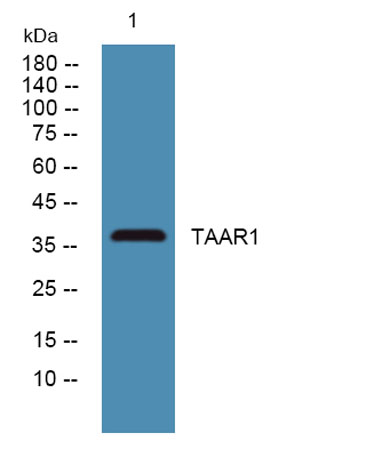
| Observed band (KD) | 37kD |
| Background | The protein encoded by this gene is a G-protein coupled receptor activated by trace amines. The encoded protein responds little or not at all to dopamine, serotonin, epinephrine, or histamine, but responds well to beta-phenylethylamine, p-tyramine, octopamine, and tryptamine. While primarily functioning in neurologic systems, there is evidence that this gene is involved in blood cell and immunologic functions as well. This gene is thought to be intronless. [provided by RefSeq, Nov 2015], |
| Function | function:Receptor for trace amines, including beta-phenylethylamine (b-PEA), p-tyramine (p-TYR), octopamine and tryptamine, with highest affinity for b-PEA and p-TYR. Unresponsive to classical biogenic amines, such as epinephrine and histamine and only partially activated by dopamine and serotonine. Trace amines are biogenic amines present in very low levels in mammalian tissues. Although some trace amines have clearly defined roles as neurotransmitters in invertebrates, the extent to which they function as true neurotransmitters in vertebrates has remained speculative. Trace amines are likely to be involved in a variety of physiological functions that have yet to be fully understood. The signal transduced by this receptor is mediated by the G(s)-class of G-proteins which activate adenylate cyclase.,similarity:Belongs to the G-protein coupled receptor 1 family.,tissue specificity:Detecte |
| Subcellular location | Cell membrane; Multi-pass membrane protein. |
| Expression | Detected in low levels in discrete regions within the central nervous system and in several peripheral tissues. Moderately expressed in stomach. Low levels in amygdala, kidney, and lung, and small intestine. Trace amounts in cerebellum, dorsal root ganglia, hippocampus, hypothalamus, liver, medulla, pancreas, pituitary, pontine reticular formation, prostate, skeletal muscle and spleen. |

Use collapsible tabs for more detailed information that will help customers make a purchasing decision.
Ex: Shipping and return policies, size guides, and other common questions.