 Français
 English

| ELK.No | ES11657 |
| Product name | MRGX2 rabbit pAb |
| Reactivity | Human;Mouse |
| Applications | WB;ELISA |
| Other name | |
| Size | 50μL |
| Unit price ($) | 148 |
| Human gene ID | 117194 |
| Human Swiss-Prot | Q96LB1 |
| Source | Rabbit |
| Isotype | IgG |
| Target | MRGX2 |
| Fields | |
| Gene name | MRGPRX2 MRGX2 |
| Protein name | Mas-related G-protein coupled receptor member X2 |
| Human gene link | |
| Human Swiss link | View Human Swiss-Prot |
| Mouse gene ID | |
| Mouse gene link | |
| Mouse Swiss-Prot | Q3UG50 |
| Mouse Swiss link | View Mouse Swiss-Prot |
| Rat gene ID | |
| Rat gene link | |
| Rat Swiss-Prot | |
| Rat Swiss link | |
| Immunogen | Synthesized peptide derived from human protein . at AA range: 250-330 |
| Specificity | MRGX2 Polyclonal Antibody detects endogenous levels of protein. |
| Formulation | Liquid in PBS containing 50% glycerol, and 0.02% sodium azide. |
| Clonality | Polyclonal |
| Dilution | WB 1:500-2000 ELISA 1:5000-20000 |
| Purification | The antibody was affinity-purified from rabbit antiserum by affinity-chromatography using epitope-specific immunogen. |
| Concentration | 1 mg/ml |
| Storage stability | -20°C/1 year |
| Molecular Weight (Da) | |
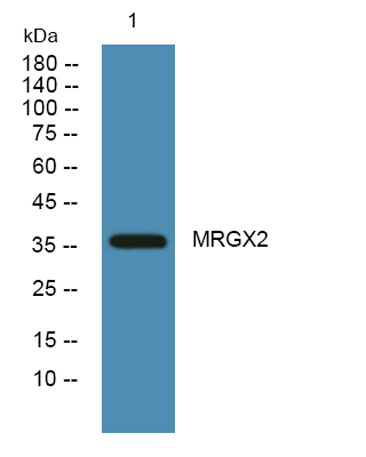
| Observed band (KD) | 36kD |
| Background | function:Orphan receptor. Probably involved in the function of nociceptive neurons. May regulate nociceptor function and/or development, including the sensation or modulation of pain. Cortistatin-14 seems to be a high potency ligand at this receptor. Cortistatin has several biological functions including roles in sleep regulation locomotor activity, and cortical function. In receptor-expressing cells, cortistatin-stimulated increases in intracellular Ca(2+) but had no effect on basal or forskolin-stimulated cAMP levels, suggesting that this receptor is G(q)-coupled.,similarity:Belongs to the G-protein coupled receptor 1 family. Mas subfamily.,tissue specificity:Has a limited expression profile, both peripheral and within the central nervous system, with highest levels in dorsal root ganglion., |
| Function | function:Orphan receptor. Probably involved in the function of nociceptive neurons. May regulate nociceptor function and/or development, including the sensation or modulation of pain. Cortistatin-14 seems to be a high potency ligand at this receptor. Cortistatin has several biological functions including roles in sleep regulation locomotor activity, and cortical function. In receptor-expressing cells, cortistatin-stimulated increases in intracellular Ca(2+) but had no effect on basal or forskolin-stimulated cAMP levels, suggesting that this receptor is G(q)-coupled.,similarity:Belongs to the G-protein coupled receptor 1 family. Mas subfamily.,tissue specificity:Has a limited expression profile, both peripheral and within the central nervous system, with highest levels in dorsal root ganglion., |
| Subcellular location | Cell membrane; Multi-pass membrane protein . |
| Expression | Mainly expressed in mast cells. Has a limited expression profile, both peripheral and within the central nervous system, with highest levels in dorsal root ganglion (PubMed:12915402). Detected in blood vessels, scattered lymphocytes, and gastrointestinal ganglia (at protein level) (PubMed:16161007). |

Use collapsible tabs for more detailed information that will help customers make a purchasing decision.
Ex: Shipping and return policies, size guides, and other common questions.