 Français
 English

| ELK.No | ES11721 |
| Product name | OR7D4 rabbit pAb |
| Reactivity | Human;Rat;Mouse; |
| Applications | WB;ELISA |
| Other name | |
| Size | 100μL |
| Unit price ($) | 248 |
| Human gene ID | 125958 |
| Human Swiss-Prot | Q8NG98 |
| Source | Rabbit |
| Isotype | IgG |
| Target | OR7D4 |
| Fields | >>Olfactory transduction |
| Gene name | OR7D4 OR7D4P |
| Protein name | Olfactory receptor 7D4 (OR19-B) (Odorant receptor family subfamily D member 4RT) (Olfactory receptor OR19-7) |
| Human gene link | |
| Human Swiss link | View Human Swiss-Prot |
| Mouse gene ID | |
| Mouse gene link | |
| Mouse Swiss-Prot | |
| Mouse Swiss link | |
| Rat gene ID | |
| Rat gene link | |
| Rat Swiss-Prot | |
| Rat Swiss link | |
| Immunogen | Synthesized peptide derived from human protein . at AA range: 30-110 |
| Specificity | OR7D4 Polyclonal Antibody detects endogenous levels of protein. |
| Formulation | Liquid in PBS containing 50% glycerol, and 0.02% sodium azide. |
| Clonality | Polyclonal |
| Dilution | WB 1:500-2000 ELISA 1:5000-20000 |
| Purification | The antibody was affinity-purified from rabbit antiserum by affinity-chromatography using epitope-specific immunogen. |
| Concentration | 1 mg/ml |
| Storage stability | -20°C/1 year |
| Molecular Weight (Da) | |
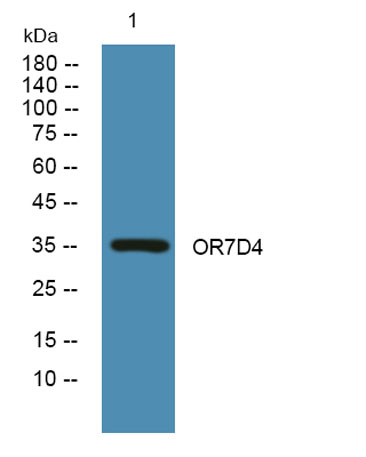
| Observed band (KD) | 34kD |
| Background | olfactory receptor family 7 subfamily D member 4(OR7D4) Homo sapiens Olfactory receptors interact with odorant molecules in the nose, to initiate a neuronal response that triggers the perception of a smell. The olfactory receptor proteins are members of a large family of G-protein-coupled receptors (GPCR) arising from single coding-exon genes. Olfactory receptors share a 7-transmembrane domain structure with many neurotransmitter and hormone receptors and are responsible for the recognition and G protein-mediated transduction of odorant signals. The olfactory receptor gene family is the largest in the genome. The nomenclature assigned to the olfactory receptor genes and proteins for this organism is independent of other organisms. [provided by RefSeq, Jul 2008], |
| Function | function:Odorant receptor. Selectively activated by androstenone and the related odorous steroid androstadienone.,online information:The selfish smell -Issue 94 of May 2008,similarity:Belongs to the G-protein coupled receptor 1 family.,tissue specificity:Nasal olfactory epithelium., |
| Subcellular location | Cell membrane; Multi-pass membrane protein. |
| Expression | Nasal olfactory epithelium. |

Use collapsible tabs for more detailed information that will help customers make a purchasing decision.
Ex: Shipping and return policies, size guides, and other common questions.