 Français
 English

| ELK.No | ES11848 |
| Product name | KISS1 rabbit pAb |
| Reactivity | Human;Mouse |
| Applications | WB;ELISA |
| Other name | |
| Size | 100μL |
| Unit price ($) | 248 |
| Human gene ID | 3814 |
| Human Swiss-Prot | Q15726 |
| Source | Rabbit |
| Isotype | IgG |
| Target | KISS1 |
| Fields | >>Neuroactive ligand-receptor interaction;>>GnRH secretion |
| Gene name | KISS1 PP5098 |
| Protein name | Metastasis-suppressor KiSS-1 (Kisspeptin-1) [Cleaved into: Metastin (Kisspeptin-54); Kisspeptin-14; Kisspeptin-13; Kisspeptin-10] |
| Human gene link | |
| Human Swiss link | View Human Swiss-Prot |
| Mouse gene ID | |
| Mouse gene link | |
| Mouse Swiss-Prot | Q6Y4S4 |
| Mouse Swiss link | View Mouse Swiss-Prot |
| Rat gene ID | |
| Rat gene link | |
| Rat Swiss-Prot | Q7TSB7 |
| Rat Swiss link | View Rat Swiss-Prot |
| Immunogen | Synthesized peptide derived from part region of human protein |
| Specificity | KISS1 Polyclonal Antibody detects endogenous levels of protein. |
| Formulation | Liquid in PBS containing 50% glycerol, and 0.02% sodium azide. |
| Clonality | Polyclonal |
| Dilution | WB 1:500-2000 ELISA 1:5000-20000 |
| Purification | The antibody was affinity-purified from rabbit antiserum by affinity-chromatography using epitope-specific immunogen. |
| Concentration | 1 mg/ml |
| Storage stability | -20°C/1 year |
| Molecular Weight (Da) | |
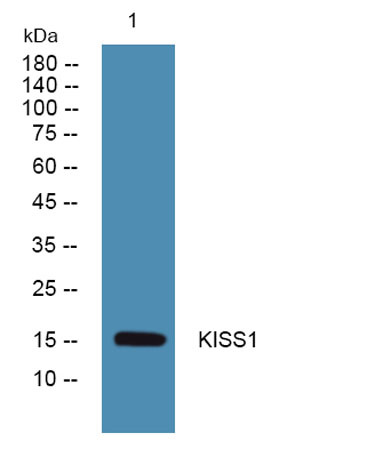
| Observed band (KD) | 15kD |
| Background | This gene is a metastasis suppressor gene that suppresses metastases of melanomas and breast carcinomas without affecting tumorigenicity. The encoded protein may inhibit chemotaxis and invasion and thereby attenuate metastasis in malignant melanomas. Studies suggest a putative role in the regulation of events downstream of cell-matrix adhesion, perhaps involving cytoskeletal reorganization. A protein product of this gene, kisspeptin, stimulates gonadotropin-releasing hormone (GnRH)-induced gonadotropin secretion and regulates the pubertal activation of GnRH nuerons. A polymorphism in the terminal exon of this mRNA results in two protein isoforms. An adenosine present at the polymorphic site represents the third position in a stop codon. When the adenosine is absent, a downstream stop codon is utilized and the encoded protein extends for an additional seven amino acid residues. [provided by R |
| Function | function:Metastasis suppressor protein in malignant melanomas and in some breast cancers. May regulate events downstream of cell-matrix adhesion, perhaps involving cytoskeletal reorganization. Generates a C-terminally amidated peptide, metastin which functions as the endogenous ligand of the G-protein coupled receptor GPR54. Activation of the receptor inhibits cell proliferation and cell migration, key characteristics of tumor metastasis. Kp-10 is a decapeptide derived from the primary translation product, isolated in conditioned medium of first trimester trophoblast. Kp-10, but not other kisspeptins, increased intracellular Ca(2+) levels in isolated first trimester trophoblasts. Kp-10 is a paracrine/endocrine regulator in fine-tuning trophoblast invasion generated by the trophoblast itself. The receptor is also essential for normal gonadotropin-released hormone physiology and for pubert |
| Subcellular location | Secreted. |
| Expression | Very high expression in placenta, with the next highest level in testis and moderate levels in pancreas, liver, small intestine and brain at much lower levels. Expression levels increased in both early placentas and molar pregnancies and are reduced in choriocarcinoma cells. Expressed at higher levels in first trimester trophoblasts than at term of gestation, but only expressed in the villous trophoblast. |

Use collapsible tabs for more detailed information that will help customers make a purchasing decision.
Ex: Shipping and return policies, size guides, and other common questions.