 Français
 English

| ELK.No | ES11870 |
| Product name | NHRF1 rabbit pAb |
| Reactivity | Human;Rat;Mouse; |
| Applications | WB;ELISA |
| Other name | |
| Size | 50μL |
| Unit price ($) | 148 |
| Human gene ID | 9368 |
| Human Swiss-Prot | O14745 |
| Source | Rabbit |
| Isotype | IgG |
| Target | NHRF1 |
| Fields | >>Tight junction;>>Parathyroid hormone synthesis, secretion and action;>>Pathogenic Escherichia coli infection;>>Human papillomavirus infection |
| Gene name | SLC9A3R1 NHERF NHERF1 |
| Protein name | Na(+)/H(+) exchange regulatory cofactor NHE-RF1 (NHERF-1) (Ezrin-radixin-moesin-binding phosphoprotein 50) (EBP50) (Regulatory cofactor of Na(+)/H(+) exchanger) (Sodium-hydrogen exchanger regulatory f |
| Human gene link | |
| Human Swiss link | View Human Swiss-Prot |
| Mouse gene ID | |
| Mouse gene link | |
| Mouse Swiss-Prot | P70441 |
| Mouse Swiss link | View Mouse Swiss-Prot |
| Rat gene ID | |
| Rat gene link | |
| Rat Swiss-Prot | Q9JJ19 |
| Rat Swiss link | View Rat Swiss-Prot |
| Immunogen | Synthesized peptide derived from part region of human protein |
| Specificity | NHRF1 Polyclonal Antibody detects endogenous levels of protein. |
| Formulation | Liquid in PBS containing 50% glycerol, and 0.02% sodium azide. |
| Clonality | Polyclonal |
| Dilution | WB 1:500-2000 ELISA 1:5000-20000 |
| Purification | The antibody was affinity-purified from rabbit antiserum by affinity-chromatography using epitope-specific immunogen. |
| Concentration | 1 mg/ml |
| Storage stability | -20°C/1 year |
| Molecular Weight (Da) | |
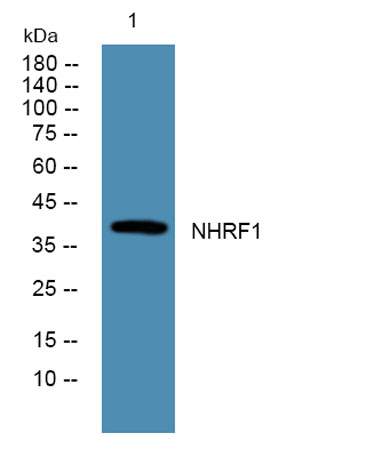
| Observed band (KD) | 39kD |
| Background | This gene encodes a sodium/hydrogen exchanger regulatory cofactor. The protein interacts with and regulates various proteins including the cystic fibrosis transmembrane conductance regulator and G-protein coupled receptors such as the beta2-adrenergic receptor and the parathyroid hormone 1 receptor. The protein also interacts with proteins that function as linkers between integral membrane and cytoskeletal proteins. The protein localizes to actin-rich structures including membrane ruffles, microvilli, and filopodia. Mutations in this gene result in hypophosphatemic nephrolithiasis/osteoporosis type 2, and loss of heterozygosity of this gene is implicated in breast cancer.[provided by RefSeq, Sep 2009], |
| Function | disease:Defects in SLC9A3R1 are the cause of hypophosphatemic nephrolithiasis/osteoporosis type 2 (NPHLOP2) [MIM:612287]. Hypophosphatemia results from idiopathic renal phosphate loss. It contributes to the pathogenesis of hypophosphatemic urolithiasis (formation of urinary calculi) as well to that of hypophosphatemic osteoporosis (bone demineralization).,function:Scaffold protein that connects plasma membrane proteins with members of the ezrin/moesin/radixin family and thereby helps to link them to the actin cytoskeleton and to regulate their surface expression. Necessary for recycling of internalized ADRB2. Was first known to play a role in the regulation of the activity and subcellular location of SLC9A3. Necessary for cAMP-mediated phosphorylation and inhibition of SLC9A3. May enhance Wnt signaling. May participate in HTR4 targeting to microvilli.,induction:By estrogen.,PTM:Phosphory |
| Subcellular location | Cytoplasm . Apical cell membrane . Endomembrane system; Peripheral membrane protein. Cell projection, filopodium. Cell projection, ruffle. Cell projection, microvillus. Translocates from the cytoplasm to the apical cell membrane in a PODXL-dependent manner. Colocalizes with CFTR at the midpiece of sperm tail (By similarity). Colocalizes with actin in microvilli-rich apical regions of the syncytiotrophoblast. Found in microvilli, ruffling membrane and filopodia of HeLa cells. Present in lipid rafts of T-cells. . |
| Expression | Detected in liver, kidney, pancreas, prostate, spleen, small intestine and placenta, in particular in the syncytiotrophoblast. |

Use collapsible tabs for more detailed information that will help customers make a purchasing decision.
Ex: Shipping and return policies, size guides, and other common questions.