 Français
 English

| ELK.No | ES11904 |
| Product name | GNB1L rabbit pAb |
| Reactivity | Human;Mouse |
| Applications | WB;ELISA |
| Other name | |
| Size | 50μL |
| Unit price ($) | 148 |
| Human gene ID | 54584 |
| Human Swiss-Prot | Q9BYB4 |
| Source | Rabbit |
| Isotype | IgG |
| Target | GNB1L |
| Fields | |
| Gene name | GNB1L GY2 KIAA1645 WDR14 FKSG1 |
| Protein name | Guanine nucleotide-binding protein subunit beta-like protein 1 (G protein subunit beta-like protein 1) (DGCRK3) (WD repeat-containing protein 14) (WD40 repeat-containing protein deleted in VCFS) (WDVC |
| Human gene link | |
| Human Swiss link | View Human Swiss-Prot |
| Mouse gene ID | |
| Mouse gene link | |
| Mouse Swiss-Prot | Q9EQ15 |
| Mouse Swiss link | View Mouse Swiss-Prot |
| Rat gene ID | |
| Rat gene link | |
| Rat Swiss-Prot | |
| Rat Swiss link | |
| Immunogen | Synthesized peptide derived from part region of human protein |
| Specificity | GNB1L Polyclonal Antibody detects endogenous levels of protein. |
| Formulation | Liquid in PBS containing 50% glycerol, and 0.02% sodium azide. |
| Clonality | Polyclonal |
| Dilution | WB 1:500-2000 ELISA 1:5000-20000 |
| Purification | The antibody was affinity-purified from rabbit antiserum by affinity-chromatography using epitope-specific immunogen. |
| Concentration | 1 mg/ml |
| Storage stability | -20°C/1 year |
| Molecular Weight (Da) | |
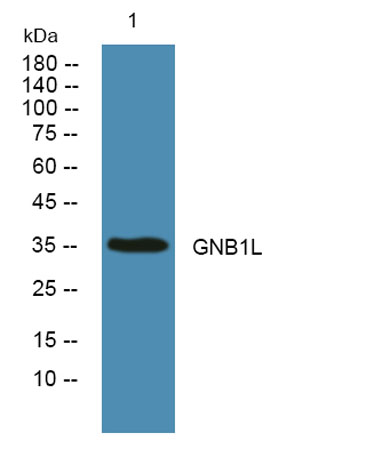
| Observed band (KD) | 35kD |
| Background | This gene encodes a G-protein beta-subunit-like polypeptide which is a member of the WD repeat protein family. WD repeats are minimally conserved regions of approximately 40 amino acids typically bracketed by gly-his and trp-asp (GH-WD), which may facilitate formation of heterotrimeric or multiprotein complexes. Members of this family are involved in a variety of cellular processes, including cell cycle progression, signal transduction, apoptosis, and gene regulation. This protein contains 6 WD repeats and is highly expressed in the heart. The gene maps to the region on chromosome 22q11, which is deleted in DiGeorge syndrome, trisomic in derivative 22 syndrome and tetrasomic in cat-eye syndrome. Therefore, this gene may contribute to the etiology of those disorders. Transcripts from this gene share exons with some transcripts from the C22orf29 gene. [provided by RefSeq, Jul 2008], |
| Function | disease:May play a part in the etiology of the velocardiofacial/DiGeorge syndrome (VCFS/DGS), a developmental disorder characterized by structural and functional palate anomalies, conotruncal cardiac malformations, immunodeficiency, hypocalcemia, and typical facial anomalies. Most cases result from a deletion of chromosome 22q11.2 (the DiGeorge syndrome chromosome region, or DGCR).,similarity:Contains 6 WD repeats.,tissue specificity:Ubiquitous. Highly expressed in heart, liver, skeletal muscle, kidney, spleen, thymus and pancreas. Detected at low levels in lung, placenta and brain., |
| Subcellular location | cytoplasm,cytoplasmic side of plasma membrane, |
| Expression | Ubiquitous. Highly expressed in heart, liver, skeletal muscle, kidney, spleen, thymus and pancreas. Detected at low levels in lung, placenta and brain. |

Use collapsible tabs for more detailed information that will help customers make a purchasing decision.
Ex: Shipping and return policies, size guides, and other common questions.