 Français
 English

| ELK.No | ES11907 |
| Product name | HLAE rabbit pAb |
| Reactivity | Human |
| Applications | WB;ELISA |
| Other name | |
| Size | 50μL |
| Unit price ($) | 148 |
| Human gene ID | 3133 |
| Human Swiss-Prot | P13747 |
| Source | Rabbit |
| Isotype | IgG |
| Target | HLAE |
| Fields | >>Endocytosis;>>Phagosome;>>Cellular senescence;>>Cell adhesion molecules;>>Antigen processing and presentation;>>Type I diabetes mellitus;>>Human cytomegalovirus infection;>>Human papillomavirus infection;>>Human T-cell leukemia virus 1 infection;>>Kaposi sarcoma-associated herpesvirus infection;>>Herpes simplex virus 1 infection;>>Epstein-Barr virus infection;>>Human immunodeficiency virus 1 infection;>>Viral carcinogenesis;>>Autoimmune thyroid disease;>>Allograft rejection;>>Graft-versus-host disease;>>Viral myocarditis |
| Gene name | HLA-E HLA-6.2 HLAE |
| Protein name | HLA class I histocompatibility antigen, alpha chain E (MHC class I antigen E) |
| Human gene link | |
| Human Swiss link | View Human Swiss-Prot |
| Mouse gene ID | |
| Mouse gene link | |
| Mouse Swiss-Prot | |
| Mouse Swiss link | |
| Rat gene ID | |
| Rat gene link | |
| Rat Swiss-Prot | |
| Rat Swiss link | |
| Immunogen | Synthesized peptide derived from part region of human protein |
| Specificity | HLAE Polyclonal Antibody detects endogenous levels of protein. |
| Formulation | Liquid in PBS containing 50% glycerol, and 0.02% sodium azide. |
| Clonality | Polyclonal |
| Dilution | WB 1:500-2000 ELISA 1:5000-20000 |
| Purification | The antibody was affinity-purified from rabbit antiserum by affinity-chromatography using epitope-specific immunogen. |
| Concentration | 1 mg/ml |
| Storage stability | -20°C/1 year |
| Molecular Weight (Da) | |
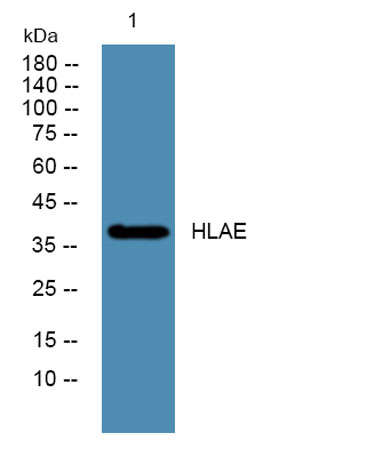
| Observed band (KD) | 39kD |
| Background | HLA-E belongs to the HLA class I heavy chain paralogues. This class I molecule is a heterodimer consisting of a heavy chain and a light chain (beta-2 microglobulin). The heavy chain is anchored in the membrane. HLA-E binds a restricted subset of peptides derived from the leader peptides of other class I molecules. The heavy chain is approximately 45 kDa and its gene contains 8 exons. Exon one encodes the leader peptide, exons 2 and 3 encode the alpha1 and alpha2 domains, which both bind the peptide, exon 4 encodes the alpha3 domain, exon 5 encodes the transmembrane region, and exons 6 and 7 encode the cytoplasmic tail. [provided by RefSeq, Jul 2008], |
| Function | caution:The existence of allele E*0102 (PubMed:3260916) and allele E*0104 (PubMed:1977695) is uncertain. The alleles could not be confirmed in further studies (PubMed:12445303).,function:Preferably binds to a peptide derived from the signal sequence of most HLA-A, -B, -C and -G molecules.,polymorphism:The following alleles of E-1 are known: E*0101, E*0102, E*0103 and E*0104. The sequence shown is that of E*0101.,similarity:Belongs to the MHC class I family.,similarity:Contains 1 Ig-like C1-type (immunoglobulin-like) domain.,subunit:Heterodimer of an alpha chain and a beta chain (beta-2-microglobulin)., |
| Subcellular location | Cell membrane ; Single-pass type I membrane protein. Golgi apparatus membrane .; [Soluble HLA class I histocompatibility antigen, alpha chain E]: Secreted . |
| Expression | Expressed in secretory endometrial cells during pregnancy (at protein level). The expression in nonlymphoid tissues is restricted to endothelial cells from all types of vessels, including arteries, veins, capillaries, and lymphatics (at protein level). In lymphoid organs, it is mainly expressed in endothelial venules, B and T cells, monocytes, macrophages, NK cells and megakaryocytes (at protein level). |

Use collapsible tabs for more detailed information that will help customers make a purchasing decision.
Ex: Shipping and return policies, size guides, and other common questions.