 Français
 English

| ELK.No | ES12280 |
| Product name | XPC rabbit pAb |
| Reactivity | Human; Mouse |
| Applications | WB |
| Other name | |
| Size | 50μL |
| Unit price ($) | 148 |
| Human gene ID | 7508 |
| Human Swiss-Prot | Q01831 |
| Source | Rabbit |
| Isotype | IgG |
| Target | XPC |
| Fields | >>Nucleotide excision repair |
| Gene name | XPC XPCC |
| Protein name | XPC |
| Human gene link | View Human Gene |
| Human Swiss link | View Human Swiss-Prot |
| Mouse gene ID | 22591 |
| Mouse gene link | View Mouse Gene |
| Mouse Swiss-Prot | P51612 |
| Mouse Swiss link | View Mouse Swiss-Prot |
| Rat gene ID | |
| Rat gene link | |
| Rat Swiss-Prot | |
| Rat Swiss link | |
| Immunogen | Synthesized peptide derived from human XPC AA range: 395-445 |
| Specificity | This antibody detects endogenous levels of XPC at Human/Mouse |
| Formulation | Liquid in PBS containing 50% glycerol, 0.5% BSA and 0.02% sodium azide. |
| Clonality | Polyclonal |
| Dilution | WB 1:500-2000 |
| Purification | The antibody was affinity-purified from rabbit serum by affinity-chromatography using specific immunogen. |
| Concentration | 1 mg/ml |
| Storage stability | -20°C/1 year |
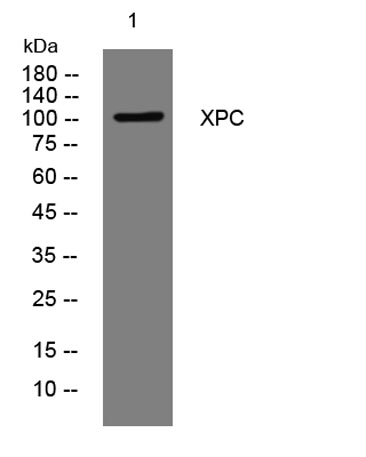
| Molecular Weight (Da) | 103kD |
| Observed band (KD) | |
| Background | This gene encodes a component of the nucleotide excision repair (NER) pathway. There are multiple components involved in the NER pathway, including Xeroderma pigmentosum (XP) A-G and V, Cockayne syndrome (CS) A and B, and trichothiodystrophy (TTD) group A, etc. This component, XPC, plays an important role in the early steps of global genome NER, especially in damage recognition, open complex formation, and repair protein complex formation. Mutations in this gene or some other NER components result in Xeroderma pigmentosum, a rare autosomal recessive disorder characterized by increased sensitivity to sunlight with the development of carcinomas at an early age. Alternatively spliced transcript variants have been found for this gene. [provided by RefSeq, Mar 2009], |
| Function | disease:Defects in XPC are a cause of xeroderma pigmentosum complementation group C (XP-C) [MIM:278720]; also known as xeroderma pigmentosum III (XP3). XP-C is a rare human autosomal recessive disease characterized by solar sensitivity, high predisposition for developing cancers on areas exposed to sunlight and, in some cases, neurological abnormalities.,function:Involved in DNA excision repair. May play a part in DNA damage recognition and/or in altering chromatin structure to allow access by damage-processing enzymes.,PTM:Phosphorylated upon DNA damage, probably by ATM or ATR.,similarity:Belongs to the XPC family.,subunit:Heterodimer of a 125 kDa subunit (p125) and of a 58 kDa subunit (p58). Interacts with CETN2., |
| Subcellular location | Nucleus . Chromosome . Cytoplasm . Omnipresent in the nucleus and consistently associates with and dissociates from DNA in the absence of DNA damage (PubMed:18682493). Continuously shuttles between the cytoplasm and the nucleus, which is impeded by the presence of NER lesions (PubMed:18682493). . |
| Expression |

Use collapsible tabs for more detailed information that will help customers make a purchasing decision.
Ex: Shipping and return policies, size guides, and other common questions.