 Français
 English
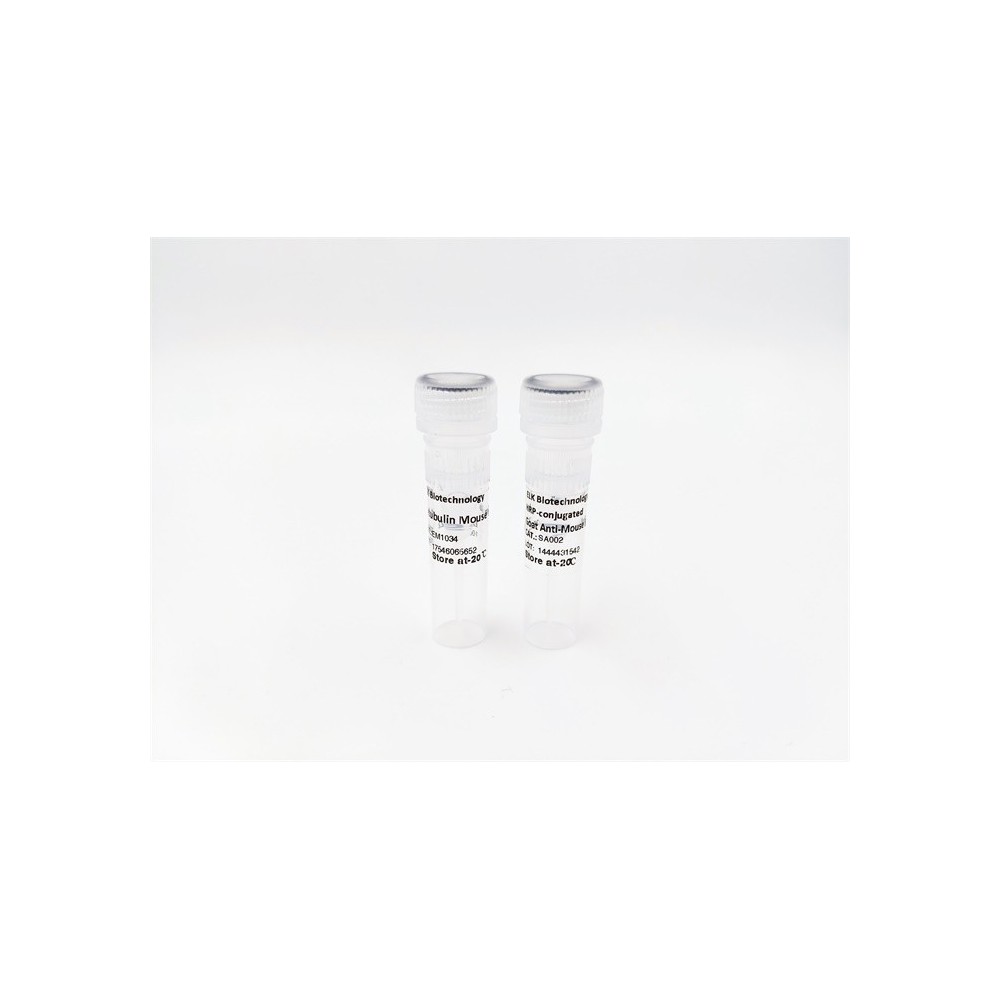

| ELK.No | ES12303 |
| Product name | WHRN rabbit pAb |
| Reactivity | Human; Mouse;Rat |
| Applications | WB |
| Other name | |
| Size | 100μL |
| Unit price ($) | 248 |
| Human gene ID | 25861 |
| Human Swiss-Prot | Q9P202 |
| Source | Rabbit |
| Isotype | IgG |
| Target | WHRN |
| Fields | |
| Gene name | WHRN DFNB31 KIAA1526 |
| Protein name | WHRN |
| Human gene link | View Human Gene |
| Human Swiss link | View Human Swiss-Prot |
| Mouse gene ID | 73750 |
| Mouse gene link | View Mouse Gene |
| Mouse Swiss-Prot | Q80VW5 |
| Mouse Swiss link | View Mouse Swiss-Prot |
| Rat gene ID | 313255 |
| Rat gene link | View Rat Gene |
| Rat Swiss-Prot | Q810W9 |
| Rat Swiss link | View Rat Swiss-Prot |
| Immunogen | Synthesized peptide derived from human WHRN AA range: 419-469 |
| Specificity | This antibody detects endogenous levels of WHRN at Human/Mouse/Rat |
| Formulation | Liquid in PBS containing 50% glycerol, 0.5% BSA and 0.02% sodium azide. |
| Clonality | Polyclonal |
| Dilution | WB 1:500-2000 |
| Purification | The antibody was affinity-purified from rabbit serum by affinity-chromatography using specific immunogen. |
| Concentration | 1 mg/ml |
| Storage stability | -20°C/1 year |
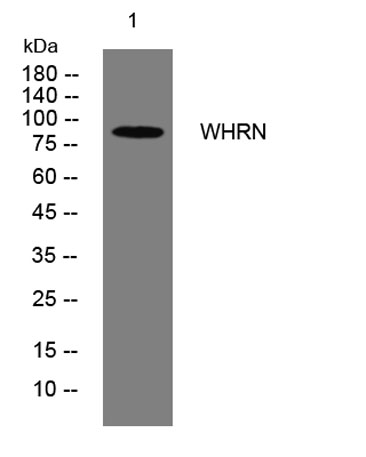
| Molecular Weight (Da) | 100kD |
| Observed band (KD) | |
| Background | This gene is thought to function in the organization and stabilization of sterocilia elongation and actin cystoskeletal assembly, based on studies of the related mouse gene. Mutations in this gene have been associated with autosomal recessive non-syndromic deafness and Usher Syndrome. Alternative splicing of this gene results in multiple transcript variants encoding different isoforms.[provided by RefSeq, Mar 2010], |
| Function | disease:Defects in WHRN are the cause of non-syndromic sensorineural deafness autosomal recessive type 31 (DFNB31) [MIM:607084]. DFNB31 is a form of sensorineural hearing loss. Sensorineural deafness results from damage to the neural receptors of the inner ear, the nerve pathways to the brain, or the area of the brain that receives sound information.,disease:Defects in WHRN are the cause of Usher syndrome type 2D (USH2D) [MIM:611383]. USH is a genetically heterogeneous condition characterized by the association of retinitis pigmentosa and sensorineural deafness. Age at onset and differences in auditory and vestibular function distinguish Usher syndrome type 1 (USH1), Usher syndrome type 2 (USH2) and Usher syndrome type 3 (USH3). USH2 is characterized by congenital mild hearing impairment with normal vestibular responses.,function:Necessary for elongation and maintenance of inner and oute |
| Subcellular location | Cytoplasm . Cell projection, stereocilium . Cell projection, growth cone . Photoreceptor inner segment . Cell junction, synapse . Detected at the level of stereocilia in inner and outer hair cells of the cochlea and vestibule. Localizes to both tip and ankle-link stereocilia regions. Colocalizes with the growing ends of actin filaments. Colocalizes with MPP1 in the retina, at the outer limiting membrane (OLM), outer plexifirm layer (OPL), basal bodies and at the connecting cilium (CC). In photoreceptors, localizes at a plasma membrane microdomain in the apical inner segment that surrounds the connecting cilia called periciliary membrane complex. . |
| Expression |

Use collapsible tabs for more detailed information that will help customers make a purchasing decision.
Ex: Shipping and return policies, size guides, and other common questions.