 Français
 English
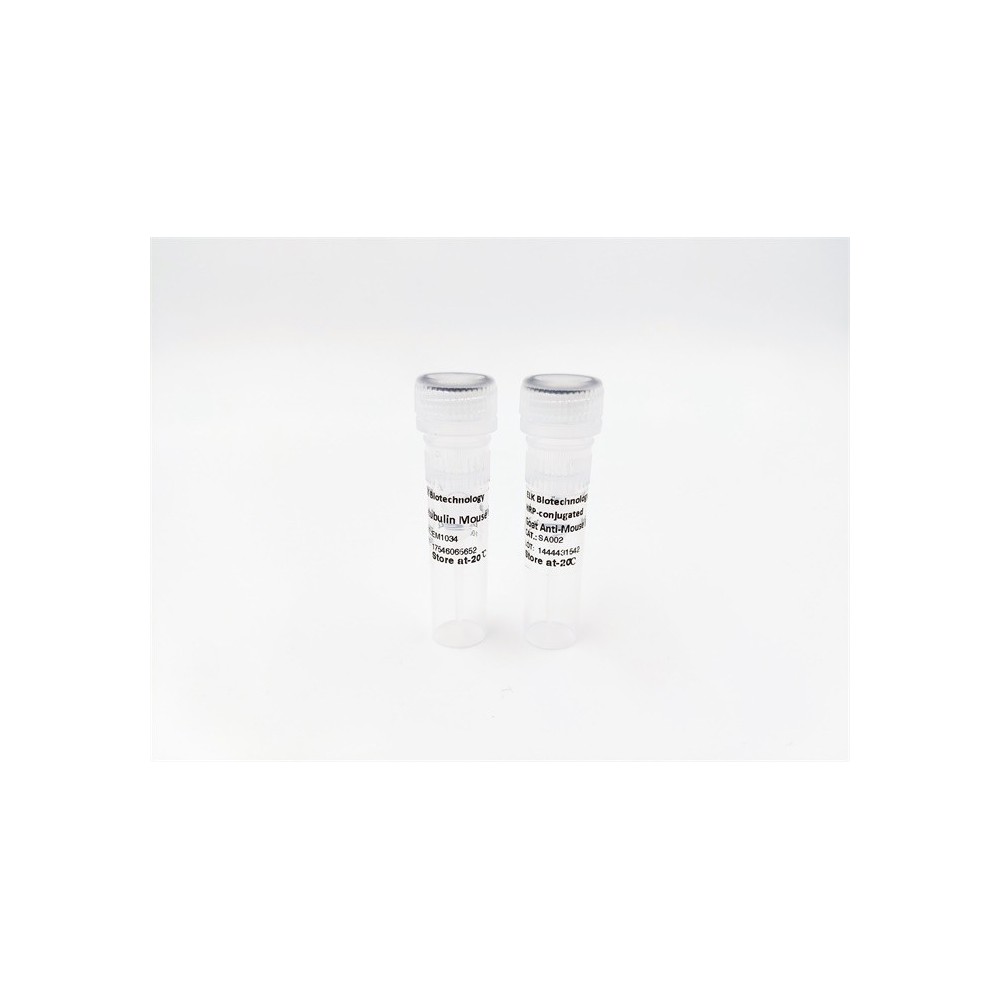

| ELK.No | ES12435 |
| Product name | UD15 rabbit pAb |
| Reactivity | Human;Rat |
| Applications | WB |
| Other name | |
| Size | 100μL |
| Unit price ($) | 248 |
| Human gene ID | 54579 |
| Human Swiss-Prot | P35504 |
| Source | Rabbit |
| Isotype | IgG |
| Target | UD15 |
| Fields | >>Pentose and glucuronate interconversions;>>Ascorbate and aldarate metabolism;>>Steroid hormone biosynthesis;>>Retinol metabolism;>>Porphyrin metabolism;>>Metabolism of xenobiotics by cytochrome P450;>>Drug metabolism - cytochrome P450;>>Drug metabolism - other enzymes;>>Metabolic pathways;>>Biosynthesis of cofactors;>>Bile secretion;>>Chemical carcinogenesis - DNA adducts;>>Chemical carcinogenesis - receptor activation |
| Gene name | UGT1A5 GNT1 UGT1 |
| Protein name | UD15 |
| Human gene link | View Human Gene |
| Human Swiss link | View Human Swiss-Prot |
| Mouse gene ID | |
| Mouse gene link | |
| Mouse Swiss-Prot | |
| Mouse Swiss link | |
| Rat gene ID | |
| Rat gene link | |
| Rat Swiss-Prot | Q64638 |
| Rat Swiss link | View Rat Swiss-Prot |
| Immunogen | Synthesized peptide derived from human UD15 AA range: 88-138 |
| Specificity | This antibody detects endogenous levels of UD15 at Human/Rat |
| Formulation | Liquid in PBS containing 50% glycerol, 0.5% BSA and 0.02% sodium azide. |
| Clonality | Polyclonal |
| Dilution | WB 1:500-2000 |
| Purification | The antibody was affinity-purified from rabbit serum by affinity-chromatography using specific immunogen. |
| Concentration | 1 mg/ml |
| Storage stability | -20°C/1 year |
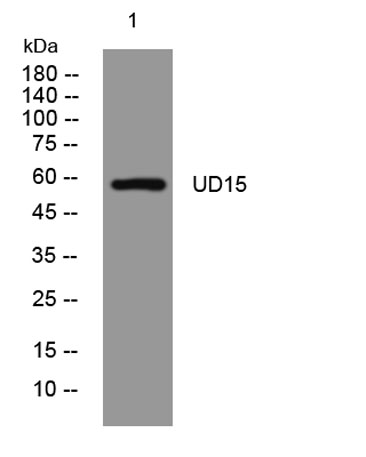
| Molecular Weight (Da) | 59kD |
| Observed band (KD) | |
| Background | This gene encodes a UDP-glucuronosyltransferase, an enzyme of the glucuronidation pathway that transforms small lipophilic molecules, such as steroids, bilirubin, hormones, and drugs, into water-soluble, excretable metabolites. This gene is part of a complex locus that encodes several UDP-glucuronosyltransferases. The locus includes thirteen unique alternate first exons followed by four common exons. Four of the alternate first exons are considered pseudogenes. Each of the remaining nine 5' exons may be spliced to the four common exons, resulting in nine proteins with different N-termini and identical C-termini. Each first exon encodes the substrate binding site, and is regulated by its own promoter. [provided by RefSeq, Jul 2008], |
| Function | alternative products:A number of isoforms are produced. The different isozymes have a different N-terminal domain and a common C-terminal domain of 245 residues,alternative products:A number of isoforms may be produced. Isoforms have a different N-terminal domain and a common C-terminal domain of 245 residues,catalytic activity:UDP-glucuronate + acceptor = UDP + acceptor beta-D-glucuronoside.,caution:The sequence shown here is derived from an Ensembl automatic analysis pipeline and should be considered as preliminary data.,disease:Defects in UGT1A1 are the cause of Crigler-Najjar syndrome type I (CN-I) [MIM:218800]. CN-I patients have severe hyperbilirubinemia and usually die of kernicterus (bilirubin accumulation in the basal ganglia and brainstem nuclei) within the first year of life. CN-I inheritance is autosomal recessive.,disease:Defects in UGT1A1 are the cause of Crigler-Najjar syn |
| Subcellular location | Endoplasmic reticulum membrane ; Single-pass membrane protein . |
| Expression | Isoform 1 and isoform 2 are expressed in colon and small intestine. Neither isoform is expressed in liver, kidney or esophagus. |

Use collapsible tabs for more detailed information that will help customers make a purchasing decision.
Ex: Shipping and return policies, size guides, and other common questions.