 Français
 English

| ELK.No | ES12490 |
| Product name | TULP3 rabbit pAb |
| Reactivity | Human; Mouse |
| Applications | WB |
| Other name | |
| Size | 100μL |
| Unit price ($) | 248 |
| Human gene ID | 7289 |
| Human Swiss-Prot | O75386 |
| Source | Rabbit |
| Isotype | IgG |
| Target | TULP3 |
| Fields | |
| Gene name | TULP3 TUBL3 |
| Protein name | TULP3 |
| Human gene link | View Human Gene |
| Human Swiss link | View Human Swiss-Prot |
| Mouse gene ID | 22158 |
| Mouse gene link | View Mouse Gene |
| Mouse Swiss-Prot | O88413 |
| Mouse Swiss link | View Mouse Swiss-Prot |
| Rat gene ID | |
| Rat gene link | |
| Rat Swiss-Prot | |
| Rat Swiss link | |
| Immunogen | Synthesized peptide derived from human TULP3 AA range: 257-307 |
| Specificity | This antibody detects endogenous levels of TULP3 at Human/Mouse |
| Formulation | Liquid in PBS containing 50% glycerol, 0.5% BSA and 0.02% sodium azide. |
| Clonality | Polyclonal |
| Dilution | WB 1:500-2000 |
| Purification | The antibody was affinity-purified from rabbit serum by affinity-chromatography using specific immunogen. |
| Concentration | 1 mg/ml |
| Storage stability | -20°C/1 year |
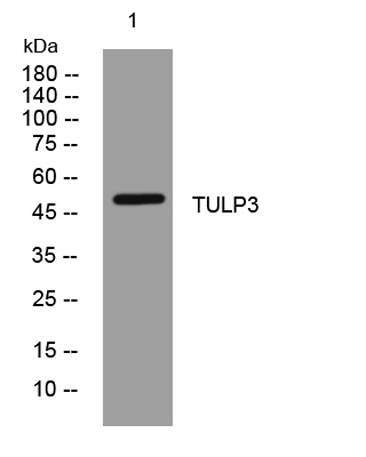
| Molecular Weight (Da) | 49kD |
| Observed band (KD) | |
| Background | This gene encodes a member of the tubby gene family of bipartite transcription factors. Members of this family have been identified in plants, vertebrates, and invertebrates, and they share a conserved N-terminal transcription activation region and a conserved C-terminal DNA and phosphatidylinositol-phosphate binding region. The encoded protein binds to phosphoinositides in the plasma membrane via its C-terminal region and probably functions as a membrane-bound transcription regulator that translocates to the nucleus in response to phosphoinositide hydrolysis, for instance, induced by G-protein-coupled-receptor signaling. It plays an important role in neuronal development and function. Two transcript variants encoding distinct isoforms have been identified for this gene. [provided by RefSeq, May 2009], |
| Function | similarity:Belongs to the TUB family.,tissue specificity:Expressed at high levels in testis, ovaries, thyroid, and spinal chord., |
| Subcellular location | Nucleus. Cell membrane. Cell projection, cilium . Cytoplasm . Secreted . Does not have a cleavable signal peptide and is secreted by a non-conventional pathway (By similarity). Translocates from the plasma membrane to the nucleus upon activation of guanine nucleotide-binding protein G(q) subunit alpha. . |
| Expression | Expressed at high levels in testis, ovaries, thyroid, and spinal chord. |

Use collapsible tabs for more detailed information that will help customers make a purchasing decision.
Ex: Shipping and return policies, size guides, and other common questions.