 Français
 English

| ELK.No | ES12736 |
| Product name | TGM5 rabbit pAb |
| Reactivity | Human; Mouse |
| Applications | WB |
| Other name | |
| Size | 100μL |
| Unit price ($) | 248 |
| Human gene ID | 9333 |
| Human Swiss-Prot | O43548 |
| Source | Rabbit |
| Isotype | IgG |
| Target | TGM5 |
| Fields | |
| Gene name | TGM5 TGMX |
| Protein name | TGM5 |
| Human gene link | View Human Gene |
| Human Swiss link | View Human Swiss-Prot |
| Mouse gene ID | 74176 |
| Mouse gene link | View Mouse Gene |
| Mouse Swiss-Prot | Q9D7I9 |
| Mouse Swiss link | View Mouse Swiss-Prot |
| Rat gene ID | |
| Rat gene link | |
| Rat Swiss-Prot | |
| Rat Swiss link | |
| Immunogen | Synthesized peptide derived from human TGM5 AA range: 448-498 |
| Specificity | This antibody detects endogenous levels of TGM5 at Human/Mouse |
| Formulation | Liquid in PBS containing 50% glycerol, 0.5% BSA and 0.02% sodium azide. |
| Clonality | Polyclonal |
| Dilution | WB 1:500-2000 |
| Purification | The antibody was affinity-purified from rabbit serum by affinity-chromatography using specific immunogen. |
| Concentration | 1 mg/ml |
| Storage stability | -20°C/1 year |
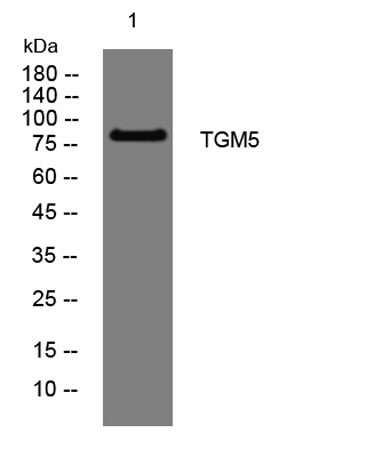
| Molecular Weight (Da) | 79kD |
| Observed band (KD) | |
| Background | This gene encodes a member of the transglutaminase family. The encoded protein catalyzes formation of protein cross-links between glutamine and lysine residues, often resulting in stabilization of protein assemblies. This reaction is calcium dependent. Mutations in this gene have been associated with acral peeling skin syndrome. [provided by RefSeq, Oct 2009], |
| Function | catalytic activity:Protein glutamine + alkylamine = protein N(5)-alkylglutamine + NH(3).,caution:The sequence shown here is derived from an Ensembl automatic analysis pipeline and should be considered as preliminary data.,cofactor:Binds 1 calcium ion per subunit.,disease:Defects in TGM5 are a cause of peeling skin syndrome acral type (APSS) [MIM:609796, 270300]. Peeling skin syndrome (PSS) is an autosomal recessive genodermatosis characterized by the continuous shedding of the outer layers of the epidermis from birth and throughout life. In some cases of PSS, skin peeling is accompanied by erythema, vesicular lesions, or, in rare cases, other ectodermal features, like fragile hair and nail abnormalities. Two main subtypes, noninflammatory type A and inflammatory type B, have been suggested. However, it is clear from the dermatology literature that there are additional subtypes. In some f |
| Subcellular location | Cytoplasm . Associated with intermediate filaments. |
| Expression | Expressed in foreskin keratinocytes. |

Use collapsible tabs for more detailed information that will help customers make a purchasing decision.
Ex: Shipping and return policies, size guides, and other common questions.