 Français
 English
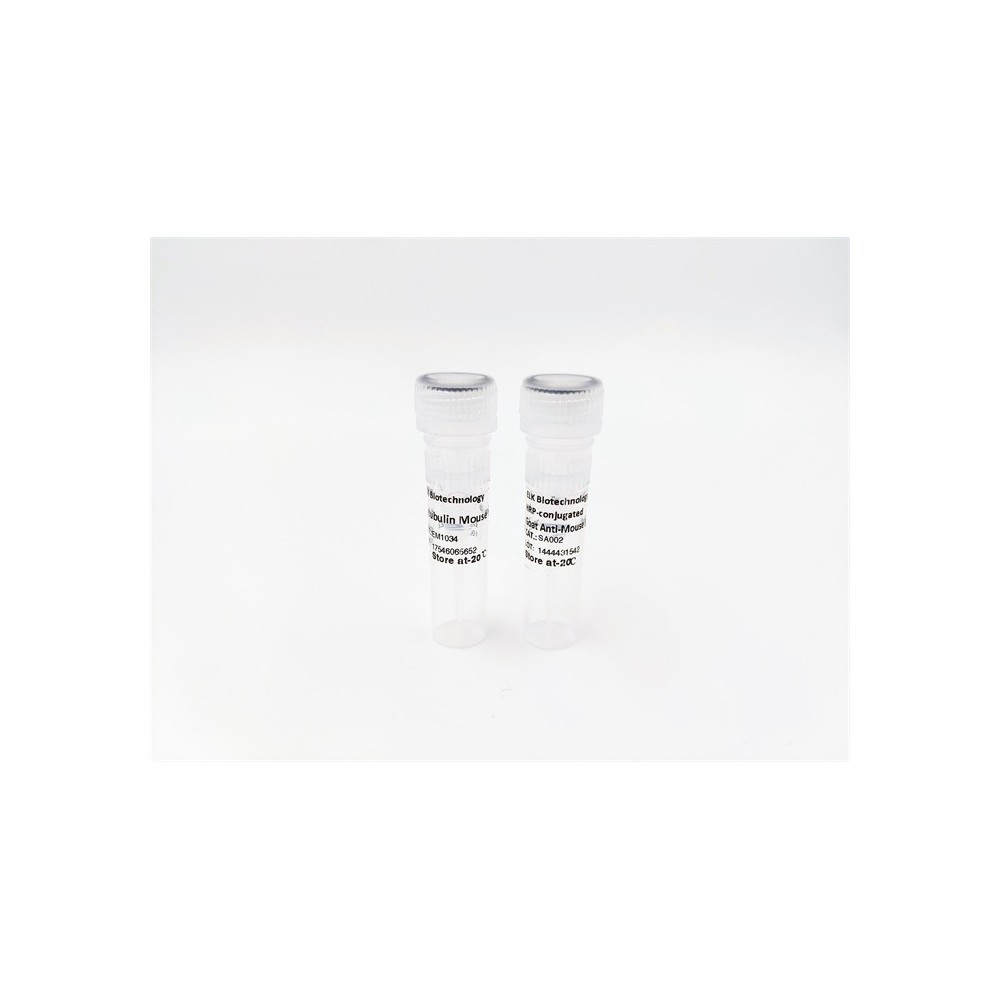

| ELK.No | ES12767 |
| Product name | TDH rabbit pAb |
| Reactivity | Human; Mouse |
| Applications | WB |
| Other name | |
| Size | 100μL |
| Unit price ($) | 248 |
| Human gene ID | |
| Human Swiss-Prot | Q8IZJ6 |
| Source | Rabbit |
| Isotype | IgG |
| Target | TDH |
| Fields | |
| Gene name | TDH |
| Protein name | TDH |
| Human gene link | |
| Human Swiss link | View Human Swiss-Prot |
| Mouse gene ID | 58865 |
| Mouse gene link | View Mouse Gene |
| Mouse Swiss-Prot | Q8K3F7 |
| Mouse Swiss link | View Mouse Swiss-Prot |
| Rat gene ID | |
| Rat gene link | |
| Rat Swiss-Prot | |
| Rat Swiss link | |
| Immunogen | Synthesized peptide derived from human TDH AA range: 169-219 |
| Specificity | This antibody detects endogenous levels of TDH at Human/Mouse |
| Formulation | Liquid in PBS containing 50% glycerol, 0.5% BSA and 0.02% sodium azide. |
| Clonality | Polyclonal |
| Dilution | WB 1:500-2000 |
| Purification | The antibody was affinity-purified from rabbit serum by affinity-chromatography using specific immunogen. |
| Concentration | 1 mg/ml |
| Storage stability | -20°C/1 year |
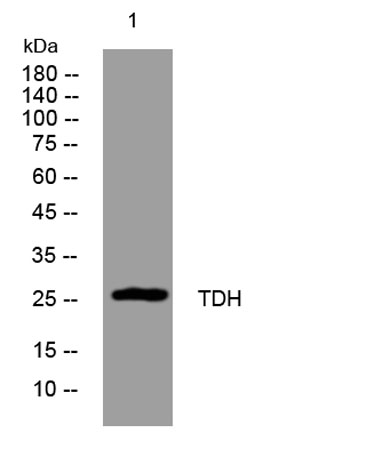
| Molecular Weight (Da) | 25kD |
| Observed band (KD) | |
| Background | This gene appears to be an evolving pseudogene of L-threonine 3-dehydrogenase (TDH). In both prokaryotes and eukaryotes, TDH catalyzes the first of two steps in one of two L-threonine degradation pathways. However, in human, the single gene with sequence similarity to TDH is not capable of encoding a functional TDH protein; the predicted protein lacks most of the C-terminus and parts of the NAD+ binding motif when compared to other species' TDH proteins. This suggests that the human gene is therefore a pseudogene. Transcripts of this gene are found in all tissues and alternatively spliced transcripts have been described. It is not known if these transcripts are translated, or if the possible protein product provides any functional role. [provided by RefSeq, Jul 2008], |
| Function | caution:According to PubMed:12361482, the human TDH gene is an expressed pseudogene encoding non-functional truncated proteins that are unable to make appropriate contacts with the substrates, L-threonine and NAD(+). Although all exons expected to encode a functional L-threonine 3-dehydrogenase of 369 residues are present in the human genome, all transcripts described encode truncated proteins that result from mutations within the gene causing the loss of acceptor splice site preceding exon 4 and exon 6.,similarity:Belongs to the sugar epimerase family.,tissue specificity:Expressed in all tissues examined. Detected in most cell types examined, but not observed in endothelial cells, glioma cell lines and some leukemia cell lines., |
| Subcellular location | Mitochondrion . |
| Expression | Expressed in all tissues examined. Detected in most cell types examined, but not observed in endothelial cells, glioma cell lines and some leukemia cell lines. |

Use collapsible tabs for more detailed information that will help customers make a purchasing decision.
Ex: Shipping and return policies, size guides, and other common questions.