 Français
 English

| ELK.No | ES12835 |
| Product name | T2H2L rabbit pAb |
| Reactivity | Human;Rat;Mouse; |
| Applications | WB |
| Other name | |
| Size | 50μL |
| Unit price ($) | 148 |
| Human gene ID | 728340 |
| Human Swiss-Prot | Q6P1K8 |
| Source | Rabbit |
| Isotype | IgG |
| Target | T2H2L |
| Fields | >>Basal transcription factors;>>Nucleotide excision repair;>>Viral carcinogenesis |
| Gene name | GTF2H2C; GTF2H2D |
| Protein name | T2H2L |
| Human gene link | View Human Gene |
| Human Swiss link | View Human Swiss-Prot |
| Mouse gene ID | |
| Mouse gene link | |
| Mouse Swiss-Prot | |
| Mouse Swiss link | |
| Rat gene ID | |
| Rat gene link | |
| Rat Swiss-Prot | |
| Rat Swiss link | |
| Immunogen | Synthesized peptide derived from human T2H2L AA range: 275-325 |
| Specificity | This antibody detects endogenous levels of T2H2L at Human |
| Formulation | Liquid in PBS containing 50% glycerol, 0.5% BSA and 0.02% sodium azide. |
| Clonality | Polyclonal |
| Dilution | WB 1:500-2000 |
| Purification | The antibody was affinity-purified from rabbit serum by affinity-chromatography using specific immunogen. |
| Concentration | 1 mg/ml |
| Storage stability | -20°C/1 year |
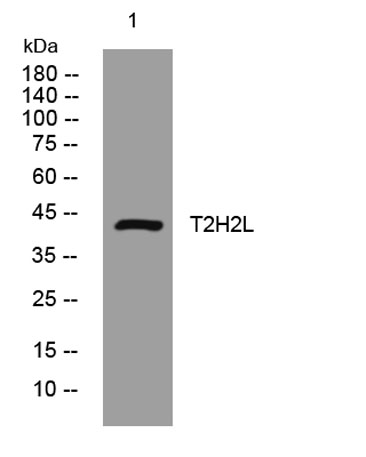
| Molecular Weight (Da) | 43kD |
| Observed band (KD) | |
| Background | |
| Function | alternative products:A number of isoforms may be produced. The isoforms may be also produced by incomplete gene duplication,function:Component of the core-TFIIH basal transcription factor involved in nucleotide excision repair (NER) of DNA and, when complexed to CAK, in RNA transcription by RNA polymerase II.,function:Component of the core-TFIIH basal transcription factor involved in nucleotide excision repair (NER) of DNA and, when complexed to CAK, in RNA transcription by RNA polymerase II. The N-terminus interacts with and regulates XPD whereas an intact C-terminus is required for a successful escape of RNAP II form the promoter.,similarity:Belongs to the GTF2H2 family.,similarity:Contains 1 VWFA domain.,subunit:One of the six subunits forming the core-TFIIH basal transcription factor. Interacts with XPB, XPD, GTF2H1 and GTF2H3.,tissue specificity:Widely expressed, with higher express |
| Subcellular location | Nucleus . |
| Expression |

Use collapsible tabs for more detailed information that will help customers make a purchasing decision.
Ex: Shipping and return policies, size guides, and other common questions.