 Français
 English



| ELK.No | ES12971 |
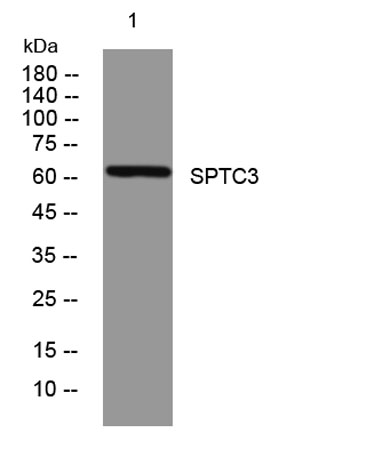
| Product name | SPTC3 rabbit pAb |
| Reactivity | Human; Mouse |
| Applications | WB |
| Other name | |
| Size | 100μL |
| Unit price ($) | 248 |
| Human gene ID | 55304 |
| Human Swiss-Prot | Q9NUV7 |
| Source | Rabbit |
| Isotype | IgG |
| Target | SPTC3 |
| Fields | >>Sphingolipid metabolism;>>Metabolic pathways;>>Sphingolipid signaling pathway |
| Gene name | SPTLC3 C20orf38 SPTLC2L |
| Protein name | SPTC3 |
| Human gene link | View Human Gene |
| Human Swiss link | View Human Swiss-Prot |
| Mouse gene ID | 228677 |
| Mouse gene link | View Mouse Gene |
| Mouse Swiss-Prot | Q8BG54 |
| Mouse Swiss link | View Mouse Swiss-Prot |
| Rat gene ID | |
| Rat gene link | |
| Rat Swiss-Prot | |
| Rat Swiss link | |
| Immunogen | Synthesized peptide derived from human SPTC3 AA range: 341-391 |
| Specificity | This antibody detects endogenous levels of SPTC3 at Human/Mouse |
| Formulation | Liquid in PBS containing 50% glycerol, 0.5% BSA and 0.02% sodium azide. |
| Clonality | Polyclonal |
| Dilution | WB 1:500-2000 |
| Purification | The antibody was affinity-purified from rabbit serum by affinity-chromatography using specific immunogen. |
| Concentration | 1 mg/ml |
| Storage stability | -20°C/1 year |
| Molecular Weight (Da) | 61kD |
| Observed band (KD) | |
| Background | The SPTLC3 gene encodes an isoform of the third subunit of serine palmitoyltransferase (SPT; EC 2.3.1.50), which catalyzes the rate-limiting step of the de novo synthesis of sphingolipids (Hornemann et al., 2006 [PubMed 17023427]). SPT contains 2 main subunits: the common SPTLC1 subunit (MIM 605712) and either SPTLC2 (MIM 605713) or its isoform SPTLC2L (SPTLC3), depending on the tissue in which biosynthesis occurs (Hornemann et al., 2006 [PubMed 17023427]). There are also 2 highly related isoforms of a third subunit, SSSPTA (MIM 613540) and SSSPTB (MIM 610412), that confer acyl-CoA preference of the SPT enzyme and are essential for maximal enzyme activity (Han et al., 2009 [PubMed 19416851]).[supplied by OMIM, Nov 2010], |
| Function | catalytic activity:Palmitoyl-CoA + L-serine = CoA + 3-dehydro-D-sphinganine + CO(2).,cofactor:Pyridoxal phosphate.,pathway:Lipid metabolism; sphingolipid metabolism.,sequence caution:Contaminating sequence. Potential poly-A sequence.,similarity:Belongs to the class-II pyridoxal-phosphate-dependent aminotransferase family.,subunit:SPTLC1, SPTLC2 and SPTLC3 may encode subunits of the enzyme.,tissue specificity:Expressed in most tissues, except peripheral blood cells and bone marrow, with highest levels in heart, kidney, liver, uterus and skin., |
| Subcellular location | Endoplasmic reticulum membrane ; Single-pass membrane protein . |
| Expression | Expressed in most tissues, except peripheral blood cells and bone marrow, with highest levels in heart, kidney, liver, uterus and skin. |

Use collapsible tabs for more detailed information that will help customers make a purchasing decision.
Ex: Shipping and return policies, size guides, and other common questions.