 Français
 English
Sox2 (phospho-Ser250/Ser251) rabbit pAb
AO-06-ES13010-50

| ELK.No | ES13010 |
| Product name | Sox2 (phospho-Ser250/Ser251) rabbit pAb |
| Reactivity | Human;Mouse |
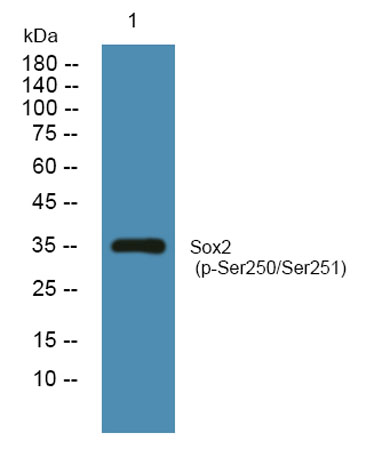
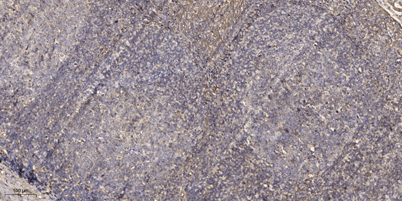
| Applications | WB;IHC |
| Other name | Transcription factor SOX-2 |
| Size | 50μL |
| Unit price ($) | 148 |
| Human gene ID | 6657 |
| Human Swiss-Prot | P48431 |
| Source | Rabbit |
| Isotype | IgG |
| Target | SOX-2 |
| Fields | >>Hippo signaling pathway;>>Signaling pathways regulating pluripotency of stem cells |
| Gene name | SOX2 |
| Protein name | Sox2 (Ser250/Ser251) |
| Human gene link | View Human Gene |
| Human Swiss link | View Human Swiss-Prot |
| Mouse gene ID | 20674 |
| Mouse gene link | View Mouse Gene |
| Mouse Swiss-Prot | P48432 |
| Mouse Swiss link | View Mouse Swiss-Prot |
| Rat gene ID | |
| Rat gene link | |
| Rat Swiss-Prot | |
| Rat Swiss link | |
| Immunogen | Synthesized phosho peptide around human Sox2 (Ser250 and Ser251) |
| Specificity | This antibody detects endogenous levels of Human Mouse Sox2 (phospho-Ser250 or Ser251) |
| Formulation | Liquid in PBS containing 50% glycerol, 0.5% BSA and 0.02% sodium azide. |
| Clonality | Polyclonal |
| Dilution | WB 1:500-2000;IHC-p 1:50-300 |
| Purification | The antibody was affinity-purified from rabbit serum by affinity-chromatography using specific immunogen. |
| Concentration | 1 mg/ml |
| Storage stability | -20°C/1 year |
| Molecular Weight (Da) | |
| Observed band (KD) | 35kD |
| Background | SRY-box 2(SOX2) Homo sapiens This intronless gene encodes a member of the SRY-related HMG-box (SOX) family of transcription factors involved in the regulation of embryonic development and in the determination of cell fate. The product of this gene is required for stem-cell maintenance in the central nervous system, and also regulates gene expression in the stomach. Mutations in this gene have been associated with optic nerve hypoplasia and with syndromic microphthalmia, a severe form of structural eye malformation. This gene lies within an intron of another gene called SOX2 overlapping transcript (SOX2OT). [provided by RefSeq, Jul 2008], |
| Function | disease:Defects in SOX2 are the cause of microphthalmia syndromic type 3 (MCOPS3) [MIM:206900]. Microphthalmia is a clinically heterogeneous disorder of eye formation, ranging from small size of a single eye to complete bilateral absence of ocular tissues (anophthalmia). In many cases, microphthalmia/anophthalmia occurs in association with syndromes that include non-ocular abnormalities. MCOPS3 is characterized by the rare association of malformations including uni- or bilateral anophthalmia or microphthalmia, and esophageal atresia with trachoesophageal fistula.,function:Transcription factor that forms a trimeric complex with OCT4 on DNA and controls the expression of a number of genes involved in embryonic development such as YES1, FGF4, UTF1 and ZFP206. Critical for early embryogenesis and for embryonic stem cell pluripotency.,online information:Sox2 entry,PTM:Sumoylation inhibits bin |
| Subcellular location | Nucleus speckle . Cytoplasm . Nucleus . Acetylation contributes to its nuclear localization and deacetylation by HDAC3 induces a cytoplasmic delocalization (By similarity). Colocalizes in the nucleus with ZNF208 isoform KRAB-O and tyrosine hydroxylase (TH) (By similarity). Colocalizes with SOX6 in speckles. Colocalizes with CAML in the nucleus (By similarity). Nuclear import is facilitated by XPO4, a protein that usually acts as a nuclear export signal receptor (By similarity). . |
| Expression | Fetal brain,Lung,Retina, |

Use collapsible tabs for more detailed information that will help customers make a purchasing decision.
Ex: Shipping and return policies, size guides, and other common questions.