 Français
 English

| ELK.No | ES13245 |
| Product name | S29A4 rabbit pAb |
| Reactivity | Human; Mouse |
| Applications | WB |
| Other name | |
| Size | 100μL |
| Unit price ($) | 248 |
| Human gene ID | 222962 |
| Human Swiss-Prot | Q7RTT9 |
| Source | Rabbit |
| Isotype | IgG |
| Target | S29A4 |
| Fields | |
| Gene name | SLC29A4 ENT4 PMAT PSEC0113 |
| Protein name | S29A4 |
| Human gene link | View Human Gene |
| Human Swiss link | View Human Swiss-Prot |
| Mouse gene ID | 243328 |
| Mouse gene link | View Mouse Gene |
| Mouse Swiss-Prot | Q8R139 |
| Mouse Swiss link | View Mouse Swiss-Prot |
| Rat gene ID | |
| Rat gene link | |
| Rat Swiss-Prot | |
| Rat Swiss link | |
| Immunogen | Synthesized peptide derived from human S29A4 AA range: 404-454 |
| Specificity | This antibody detects endogenous levels of S29A4 at Human/Mouse |
| Formulation | Liquid in PBS containing 50% glycerol, 0.5% BSA and 0.02% sodium azide. |
| Clonality | Polyclonal |
| Dilution | WB 1:500-2000 |
| Purification | The antibody was affinity-purified from rabbit serum by affinity-chromatography using specific immunogen. |
| Concentration | 1 mg/ml |
| Storage stability | -20°C/1 year |
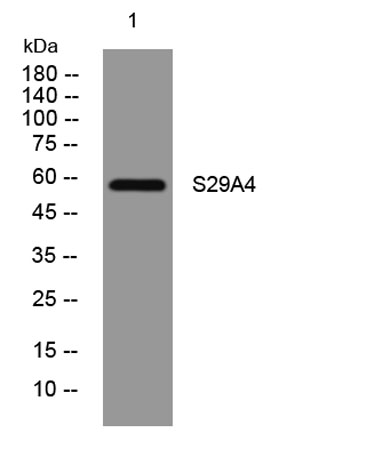
| Molecular Weight (Da) | 58kD |
| Observed band (KD) | |
| Background | This gene encodes a member of the SLC29A/ENT transporter protein family. The encoded membrane protein catalyzes the reuptake of monoamines into presynaptic neurons, thus determining the intensity and duration of monoamine neural signaling. It has been shown to transport several compounds, including serotonin, dopamine, and the neurotoxin 1-methyl-4-phenylpyridinium. Alternative splicing results in multiple transcript variants. [provided by RefSeq, Jul 2014], |
| Function | function:Functions as a polyspecific organic cation transporter, efficiently transporting many organic cations such as monoamine neurotransmitters 1-methyl-4-phenylpyridinium and biogenic amines including serotonin, dopamine, norepinephrine and epinephrine. May play a role in regulating central nervous system homeostasis of monoamine neurotransmitters. May be involved in luminal transport of organic cations in the kidney and seems to use luminal proton gradient to drive organic cation reabsorption. Does not seem to transport nucleoside and nucleoside analogs such as uridine, cytidine, thymidine, adenosine, inosine, guanosine, and azidothymidine. In (PubMed:16873718) adenosine is efficiently transported but in a fashion highly sensitive to extracellular pH, with maximal activity in the pH range 5.5 to 6.5. Glu-206 is essential for the cation selectivity and may function as the charge sens |
| Subcellular location | Cell membrane ; Multi-pass membrane protein . Apical cell membrane ; Multi-pass membrane protein . Located to the plasma membranes of ventricular myocytes and vascular endothelial cells. Targeted to the apical membranes of differentiated kidney epithelial cells. . |
| Expression | Expressed abundantly in the heart, in both cardiomyocytes and vascular endothelial cells (at protein level). Highly expressed in brain, kidney and skeletal muscle. In the brain expressed in cerebellum, cerebral cortex, medulla, occipital pole, frontal and temporal lobes putamen and in the spinal cord. Lower expression in liver, pancreas, and liver. Expressed in endometrial tissue, exclusively in the stroma. Expression is high in the proliferative phase, decreases during the secretory phase, and is no longer detectable in the menstrual phase. |

Use collapsible tabs for more detailed information that will help customers make a purchasing decision.
Ex: Shipping and return policies, size guides, and other common questions.