 Français
 English

| ELK.No | ES13249 |
| Product name | S26A7 rabbit pAb |
| Reactivity | Human; Mouse |
| Applications | WB |
| Other name | |
| Size | 50μL |
| Unit price ($) | 148 |
| Human gene ID | 115111 |
| Human Swiss-Prot | Q8TE54 |
| Source | Rabbit |
| Isotype | IgG |
| Target | S26A7 |
| Fields | >>Gastric acid secretion |
| Gene name | SLC26A7 SUT2 |
| Protein name | S26A7 |
| Human gene link | View Human Gene |
| Human Swiss link | View Human Swiss-Prot |
| Mouse gene ID | 208890 |
| Mouse gene link | View Mouse Gene |
| Mouse Swiss-Prot | Q8R2Z3 |
| Mouse Swiss link | View Mouse Swiss-Prot |
| Rat gene ID | |
| Rat gene link | |
| Rat Swiss-Prot | |
| Rat Swiss link | |
| Immunogen | Synthesized peptide derived from human S26A7 AA range: 595-645 |
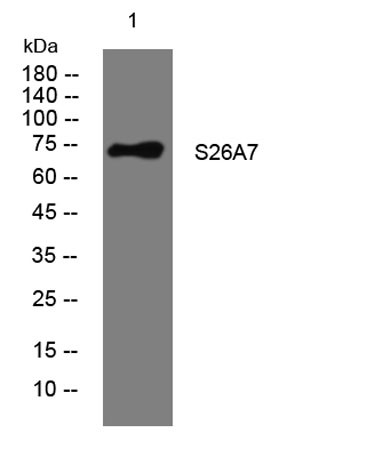
| Specificity | This antibody detects endogenous levels of S26A7 at Human/Mouse |
| Formulation | Liquid in PBS containing 50% glycerol, 0.5% BSA and 0.02% sodium azide. |
| Clonality | Polyclonal |
| Dilution | WB 1:500-2000 |
| Purification | The antibody was affinity-purified from rabbit serum by affinity-chromatography using specific immunogen. |
| Concentration | 1 mg/ml |
| Storage stability | -20°C/1 year |
| Molecular Weight (Da) | 72kD |
| Observed band (KD) | |
| Background | This gene is one member of a family of sulfate/anion transporter genes. Family members are well conserved in gene structure and protein length yet have markedly different tissue expression patterns. This gene has abundant and specific expression in the kidney. Alternatively spliced transcript variants that encode different isoforms have been described. [provided by RefSeq, Aug 2013], |
| Function | function:Acts as a sodium-independent DIDS-sensitive anion exchanger mediating bicarbonate, chloride, sulfate and oxalate transport. May play a role in the maintenance of the electrolyte and acid-base homeostasis in the kidney, by acting as a distal excretory segment-specific anion exchanger. Plays a major role in gastric acid secretion.,miscellaneous:Is active at both alkaline and acidic pH. Activity is inhibited by 4,4'-Di-isothiocyanatostilbene-2,2'-disulfonic acid (DIDS - an inhibitor of several anionic channels and transporters).,similarity:Belongs to the SLC26A/SulP transporter (TC 2.A.53) family.,similarity:Contains 1 STAS domain.,subcellular location:Expressed in the cytoplasm in recycling endosomes of medullary collecting duct cells and in acid-secreting gastric parietal cells. Targeted to the basolateral membrane in hypertonicity and potassium depletion.,tissue specificity:Expr |
| Subcellular location | Recycling endosome membrane ; Multi-pass membrane protein . Expressed in the cytoplasm in recycling endosomes of medullary collecting duct cells and in acid-secreting gastric parietal cells. Targeted to the basolateral membrane in hypertonicity and potassium depletion. . |
| Expression | Expressed in tonsillar high endothelial venule endothelial cells (HEVEC), placenta and in testis, expressed in a subgroup of basal cells in the epididymal ducts. |

Use collapsible tabs for more detailed information that will help customers make a purchasing decision.
Ex: Shipping and return policies, size guides, and other common questions.