 Français
 English

| ELK.No | ES13444 |
| Product name | RBM8A rabbit pAb |
| Reactivity | Human; Mouse;Rat |
| Applications | WB |
| Other name | |
| Size | 100μL |
| Unit price ($) | 248 |
| Human gene ID | 9939 |
| Human Swiss-Prot | Q9Y5S9 |
| Source | Rabbit |
| Isotype | IgG |
| Target | RBM8A |
| Fields | >>Nucleocytoplasmic transport;>>mRNA surveillance pathway;>>Spliceosome |
| Gene name | RBM8A RBM8 HSPC114 MDS014 |
| Protein name | RBM8A |
| Human gene link | View Human Gene |
| Human Swiss link | View Human Swiss-Prot |
| Mouse gene ID | 60365 |
| Mouse gene link | View Mouse Gene |
| Mouse Swiss-Prot | Q9CWZ3 |
| Mouse Swiss link | View Mouse Swiss-Prot |
| Rat gene ID | 295284 |
| Rat gene link | View Rat Gene |
| Rat Swiss-Prot | Q27W01 |
| Rat Swiss link | View Rat Swiss-Prot |
| Immunogen | Synthesized peptide derived from human RBM8A AA range: 118-168 |
| Specificity | This antibody detects endogenous levels of RBM8A at Human/Mouse/Rat |
| Formulation | Liquid in PBS containing 50% glycerol, 0.5% BSA and 0.02% sodium azide. |
| Clonality | Polyclonal |
| Dilution | WB 1:500-2000 |
| Purification | The antibody was affinity-purified from rabbit serum by affinity-chromatography using specific immunogen. |
| Concentration | 1 mg/ml |
| Storage stability | -20°C/1 year |
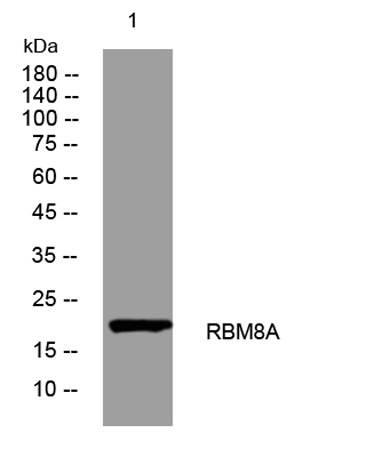
| Molecular Weight (Da) | 19kD |
| Observed band (KD) | |
| Background | This gene encodes a protein with a conserved RNA-binding motif. The protein is found predominantly in the nucleus, although it is also present in the cytoplasm. It is preferentially associated with mRNAs produced by splicing, including both nuclear mRNAs and newly exported cytoplasmic mRNAs. It is thought that the protein remains associated with spliced mRNAs as a tag to indicate where introns had been present, thus coupling pre- and post-mRNA splicing events. Previously, it was thought that two genes encode this protein, RBM8A and RBM8B; it is now thought that the RBM8B locus is a pseudogene. There are two alternate translation start codons with this gene, which result in two forms of the protein. An allele mutation and a low-frequency noncoding single-nucleotide polymorphism (SNP) in this gene cause thrombocytopenia-absent radius (TAR) syndrome. [provided by RefSeq, Jul 2013], |
| Function | function:Part of a post-splicing multiprotein complex involved in both mRNA nuclear export and mRNA surveillance. Involved in nonsense-mediated decay (NMD) of mRNAs containing premature stop codons. Associates preferentially with mRNAs produced by splicing. Does not interact with pre-mRNAs, introns, or mRNAs produced from intronless cDNAs. Associates with both nuclear mRNAs and newly exported cytoplasmic mRNAs. Complex with MAGOH is a component of the nonsense mediated decay (NMD) pathway.,sequence caution:Chimeric cDNA. A chimeric cDNA originating from chromosomes 1 and 5.,similarity:Contains 1 RRM (RNA recognition motif) domain.,subunit:Found in a mRNA splicing-dependent exon junction complex (EJC) with DEK, NCBP1, NCBP2, NXF1, RBM8A, RNPS1, RENT2, RENT3A, RENT3B, SRRM1 and THOC4. Found in a post-splicing complex with NXF1, RBM8A, RENT1, RENT2, RENT3A, RENT3B and RNPS1. Interacts with |
| Subcellular location | Nucleus . Nucleus speckle . Cytoplasm . Nucleocytoplasmic shuttling protein (PubMed:11030346). Travels to the cytoplasm as part of the exon junction complex (EJC) bound to mRNA. Colocalizes with the core EJC, ALYREF/THOC4, NXF1 and UAP56 in the nucleus and nuclear speckles (PubMed:19324961). . |
| Expression | Ubiquitous. |

Use collapsible tabs for more detailed information that will help customers make a purchasing decision.
Ex: Shipping and return policies, size guides, and other common questions.