 Français
 English

| ELK.No | ES13462 |
| Product name | RAPSN rabbit pAb |
| Reactivity | Human; Mouse |
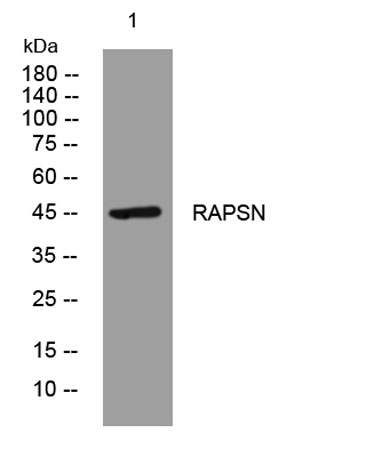
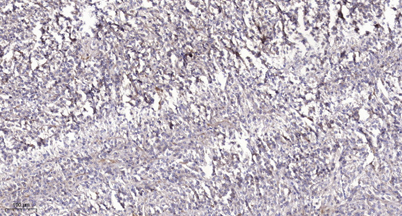
| Applications | WB;IHC |
| Other name | |
| Size | 50μL |
| Unit price ($) | 148 |
| Human gene ID | 5913 |
| Human Swiss-Prot | Q13702 |
| Source | Rabbit |
| Isotype | IgG |
| Target | RAPSN |
| Fields | |
| Gene name | RAPSN RNF205 |
| Protein name | RAPSN |
| Human gene link | View Human Gene |
| Human Swiss link | View Human Swiss-Prot |
| Mouse gene ID | 19400 |
| Mouse gene link | View Mouse Gene |
| Mouse Swiss-Prot | P12672 |
| Mouse Swiss link | View Mouse Swiss-Prot |
| Rat gene ID | |
| Rat gene link | |
| Rat Swiss-Prot | |
| Rat Swiss link | |
| Immunogen | Synthesized peptide derived from human RAPSN AA range: 341-391 |
| Specificity | This antibody detects endogenous levels of RAPSN at Human/Mouse |
| Formulation | Liquid in PBS containing 50% glycerol, 0.5% BSA and 0.02% sodium azide. |
| Clonality | Polyclonal |
| Dilution | WB 1:500-2000;IHC-p 1:50-300 |
| Purification | The antibody was affinity-purified from rabbit serum by affinity-chromatography using specific immunogen. |
| Concentration | 1 mg/ml |
| Storage stability | -20°C/1 year |
| Molecular Weight (Da) | 45kD |
| Observed band (KD) | |
| Background | This gene encodes a member of a family of proteins that are receptor associated proteins of the synapse. The encoded protein contains a conserved cAMP-dependent protein kinase phosphorylation site, and plays a critical role in clustering and anchoring nicotinic acetylcholine receptors at synaptic sites by linking the receptors to the underlying postsynaptic cytoskeleton, possibly by direct association with actin or spectrin. Mutations in this gene may play a role in postsynaptic congenital myasthenic syndromes. Alternatively spliced transcript variants encoding multiple isoforms have been observed for this gene. [provided by RefSeq, Apr 2011], |
| Function | disease:Defects in RAPSN are a cause of congenital myasthenic syndrome type 1d (CMS1D) [MIM:608931]; also called congenital myasthenic syndrome associated with acetylcholine receptor deficiency. Congenital myasthenic syndromes (CMS) are inherited disorders of neuromuscular transmission that stem from mutations in presynaptic, synaptic, or postsynaptic proteins. Postsynaptic disorders result from mutations in proteins forming the subunits of the muscle acetylcholine receptor (AChR). The kinetic abnormalities of AChR result in either prolonged ion channel activations that underlie "slow-channel myasthenic syndromes" (SCCMS) or abbreviated channel activations that underlie the abnormally rapid decay of endplate currents in "fast-channel syndromes" (FCCMS). CMS1D is the third disorder associated with postsynaptic CMS which could result from mutations in the proteins forming the muscle AChR. |
| Subcellular location | Cell membrane; Peripheral membrane protein; Cytoplasmic side. Cell junction, synapse, postsynaptic cell membrane; Peripheral membrane protein; Cytoplasmic side. Cytoplasm, cytoskeleton. Cytoplasmic surface of postsynaptic membranes. |
| Expression |

Use collapsible tabs for more detailed information that will help customers make a purchasing decision.
Ex: Shipping and return policies, size guides, and other common questions.