 Français
 English

| ELK.No | ES13818 |
| Product name | RAB7A rabbit pAb |
| Reactivity | Human; Mouse;Rat |
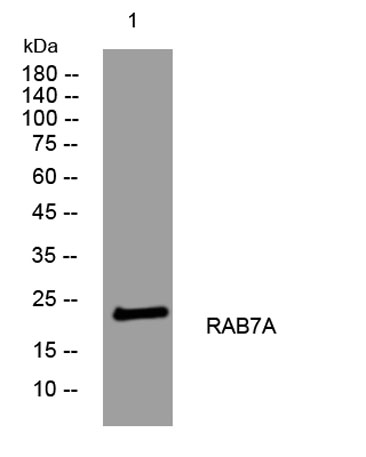
| Applications | WB |
| Other name | |
| Size | 50μL |
| Unit price ($) | 148 |
| Human gene ID | 7879 |
| Human Swiss-Prot | P51149 |
| Source | Rabbit |
| Isotype | IgG |
| Target | RAB7A |
| Fields | >>Mitophagy - animal;>>Autophagy - animal;>>Endocytosis;>>Phagosome;>>Salmonella infection;>>Amoebiasis;>>Tuberculosis |
| Gene name | RAB7A RAB7 |
| Protein name | RAB7A |
| Human gene link | View Human Gene |
| Human Swiss link | View Human Swiss-Prot |
| Mouse gene ID | 19349 |
| Mouse gene link | View Mouse Gene |
| Mouse Swiss-Prot | P51150 |
| Mouse Swiss link | View Mouse Swiss-Prot |
| Rat gene ID | 29448 |
| Rat gene link | View Rat Gene |
| Rat Swiss-Prot | P09527 |
| Rat Swiss link | View Rat Swiss-Prot |
| Immunogen | Synthesized peptide derived from human RAB7A AA range: 84-134 |
| Specificity | This antibody detects endogenous levels of RAB7A at Human/Mouse/Rat |
| Formulation | Liquid in PBS containing 50% glycerol, 0.5% BSA and 0.02% sodium azide. |
| Clonality | Polyclonal |
| Dilution | WB 1:500-2000 |
| Purification | The antibody was affinity-purified from rabbit serum by affinity-chromatography using specific immunogen. |
| Concentration | 1 mg/ml |
| Storage stability | -20°C/1 year |
| Molecular Weight (Da) | 23kD |
| Observed band (KD) | |
| Background | RAB family members are small, RAS-related GTP-binding proteins that are important regulators of vesicular transport. Each RAB protein targets multiple proteins that act in exocytic / endocytic pathways. This gene encodes a RAB family member that regulates vesicle traffic in the late endosomes and also from late endosomes to lysosomes. This encoded protein is also involved in the cellular vacuolation of the VacA cytotoxin of Helicobacter pylori. Mutations at highly conserved amino acid residues in this gene have caused some forms of Charcot-Marie-Tooth (CMT) type 2 neuropathies. [provided by RefSeq, Jul 2008], |
| Function | disease:Defects in RAB7A are the cause of Charcot-Marie-Tooth disease type 2B (CMT2B) [MIM:600882]; also known as hereditary motor and sensory neuropathy II (HMSN2). CMT2B is a form of Charcot-Marie-Tooth disease, the most common inherited disorder of the peripheral nervous system. Charcot-Marie-Tooth disease is classified in two main groups on the basis of electrophysiologic properties and histopathology: primary peripheral demyelinating neuropathy or CMT1, and primary peripheral axonal neuropathy or CMT2. Neuropathies of the CMT2 group are characterized by signs of axonal regeneration in the absence of obvious myelin alterations, normal or slightly reduced nerve conduction velocities, and progressive distal muscle weakness and atrophy. CMT2B is clinically characterized by marked distal muscle weakness and a high frequency of foot ulcers, infections and amputations of the toes. CMT2B in |
| Subcellular location | Cytoplasmic vesicle, phagosome membrane ; Peripheral membrane protein ; Cytoplasmic side . Late endosome membrane ; Peripheral membrane protein ; Cytoplasmic side . Lysosome membrane ; Peripheral membrane protein ; Cytoplasmic side . Melanosome membrane ; Peripheral membrane protein ; Cytoplasmic side . Cytoplasmic vesicle, autophagosome membrane ; Peripheral membrane protein ; Cytoplasmic side . Lipid droplet . Endosome membrane ; Peripheral membrane protein . Cytoplasmic vesicle . Mitochondrion membrane ; Peripheral membrane protein . Colocalizes with OSBPL1A at the late endosome (PubMed:16176980). Found in the ruffled border (a late endosomal-like compartment in the plasma membrane) of bone-resorbing osteoclasts. Recruited to phagosomes containing S.aureus or Mycobacterium (PubMed:21255 |
| Expression | Widely expressed; high expression found in skeletal muscle. |

Use collapsible tabs for more detailed information that will help customers make a purchasing decision.
Ex: Shipping and return policies, size guides, and other common questions.